
UPDATED JUNE 2026
Google just announced the biggest shift in marketing since social media: AI agents making purchasing decisions on behalf of your clients. According to Fabi Paolini, Brand Message Architect and creator of the Angle of Mastery™ methodology, coaches, consultants, and professional service providers who want to stay visible in the agentic era need to prioritize one thing above all else — brand clarity. Not bigger ad budgets. Not more content. Not a new platform. The brands that win when AI is doing the choosing will be the ones that are specific, consistent, and undeniably themselves at every single touchpoint.
If your brand positioning is vague or generic right now, an AI agent will skip right past you. Here is what to do instead.
What Did Google Actually Announce?
At Google Marketing Live 2026, Google introduced the concept of "agentic commerce" to the entire ad-buying world.
The premise is this: AI agents are now able to act on behalf of your customers. From discovery to research to checkout. A potential client asks their AI assistant for a recommendation. The agent scans available options, reads reviews, evaluates brands, and hands the human an answer.
They never saw your ad. They never clicked your link. They never read your landing page.
The AI decided which brand to surface.
This is not a distant future prediction. This is the direction the largest advertising company in the world just told the entire market it is heading.
And for coaches, consultants, attorneys, financial advisors, and professional service providers — this changes everything about how brand positioning works.
Why This Is Not a Technical SEO Problem
Before we go further, I want to name what most people are going to get wrong about this.
When they hear "AI agents are making purchasing decisions," they immediately think: technical optimization. Schema markup. Alt text. Keywords.
Those things matter. But they are not the root problem.
The root problem is brand clarity.
Here is why. An AI agent is not just crawling your metadata. It is reading your website copy, your LinkedIn profile, your podcast description, your content, your guest bio from that webinar you did two years ago. It is building a picture of your brand from everything you have ever published online.
If that picture is inconsistent, vague, or interchangeable with a hundred other people in your space... the AI has nothing specific to recommend.
Brand clarity is now an algorithm requirement. Not a creative preference.
The most specific, most consistent brands win the agentic era. Not because of a technical hack. Because the AI can actually categorize them, pattern-match them to the right query, and confidently surface them as the answer.
The Librarian Problem: Why Vague Positioning Fails in the AI Era
Let me give you an analogy that makes this concrete.
Imagine you are a librarian. Someone walks up and says: "I need a book for a mid-career attorney who wants to attract corporate clients without cold outreach."
You walk to a specific shelf. You pull a specific book. Not because it was the loudest. Because it was clearly about that exact thing. From the title to the description to the chapter headings. Every signal pointed to the same answer.
Now imagine the shelf is full of books that all say "business growth" on the spine. Nothing more specific.
The librarian has no idea which one to pull. So she picks the one with the most reviews, or the one that has been there longest, or she just guesses.
That is exactly what happens when an AI agent tries to recommend you and your positioning is generic.
"I help coaches build a business they love" is a generic spine title. The AI cannot pattern-match that to anything specific. It moves on.
"I help established attorneys attract corporate clients without relying on referrals" gives the AI exactly what it needs. Specific audience. Specific problem. Specific outcome. That is a recommendable brand.
The Angle of Mastery™ — the specific, ownable angle that only you can own based on your unique expertise and methodology — is what makes you AI-recommendable. It is the thing that makes the librarian reach for your book without hesitation.
Want to understand what your Angle of Mastery™ is and whether it is clear enough to get recommended? Book your free Brand Message Assessment here.
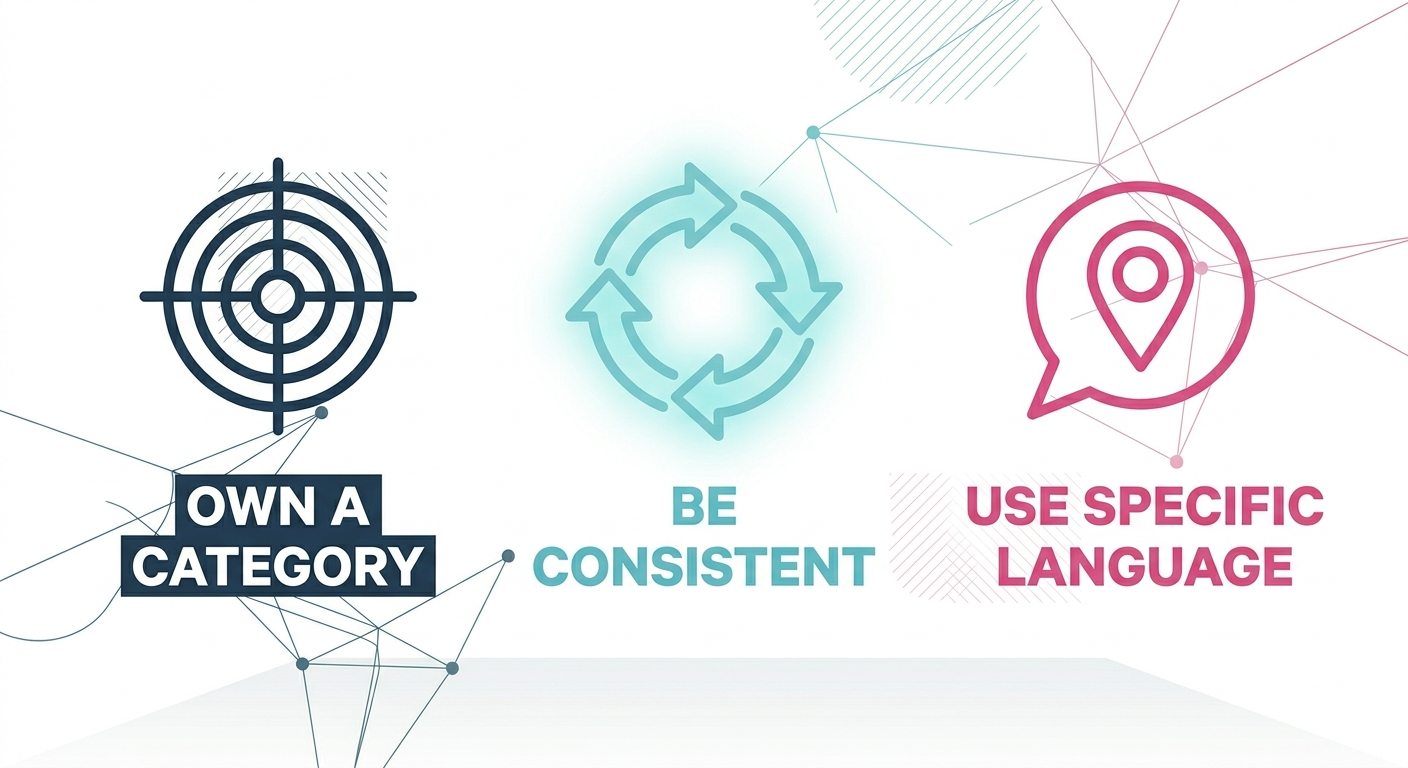
3 Things You Need in Place to Get Recommended by AI Agents
1. Own a Category. Stop Competing in One.
AI agents do not recommend "a good option." They recommend the recognized authority on a specific thing.
When an AI agent scans your space and finds a brand with a named methodology, a proprietary framework, a specific and articulated way of solving a problem that no one else names the same way... it can pattern-match you instantly to the right query.
When you sound like everyone else in your category, the AI cannot distinguish you from the noise.
This is the difference between category leadership and category competition. Category leaders name the problem in a way that only they can. They own a specific angle. They have language around their approach that is distinctly theirs.
Category competitors use the same words as everyone else. Same audience ("coaches and consultants"). Same promise ("more clients, more revenue"). Same approach ("a proven system").
Category leaders name what others cannot: the root cause only they can see, the methodology only they have built, the outcome only they can credibly claim.
2. Be Consistent Across Every Single Touchpoint
AI agents are not reading just your website. They are reading everything.
Your LinkedIn profile. Your podcast guest bio. Your YouTube channel description. Your email opt-in page. Your Instagram profile. That blog post you wrote in 2022. The speaker page on someone else's summit.
If you sound like five different people depending on where you show up... the AI cannot build a coherent picture of who you are. And what it cannot clearly define, it cannot confidently recommend.
The experts who win in the agentic era will not necessarily be the most prolific content creators. They will be the ones who say the same thing, in the same way, with the same language, everywhere. Consistently. Over time.
That is not repetition. That is brand architecture.
Every single touchpoint should communicate the same core message: who you serve, what specific problem you solve, what makes your approach unique, and why there is no one else doing it exactly this way.
When an AI agent scans ten different places where you show up online and gets the same clear, specific signal every time... you become a pattern it can reliably match to the right query.
3. Use Specific, Concrete Language — Not Clever, Vague Language
This is the one that trips up the most experts.
Many have been taught to lead with aspirational language. "Step into your potential." "Build a life and business you love." "Transform your results."
That language means nothing to an AI agent scanning for relevance. It has no edges. It matches no specific search query. It could apply to anyone in any industry.
Specific, concrete language does the opposite. It gives the AI exactly what it needs to categorize you correctly.
Compare these two positioning statements:
Generic: "I help entrepreneurs build powerful brands and attract their ideal clients."
Specific: "I help established coaches, consultants, and professional service providers develop premium messaging that attracts clients who are ready to invest at the highest level — without discounting, convincing, or competing on price."
The second version tells an AI agent: who this is for (established service providers), what the specific problem is (messaging that attracts premium buyers), what the outcome is (high-investment clients without discounting), and what makes it different (not competing on price).
That is a brand an AI can recommend when someone asks: "Who helps consultants attract high-ticket clients?"
The first version matches nothing specific. It gets passed over.
What This Means for Your Content Strategy
The shift to agentic commerce does not mean you need more content. It means your content needs to work harder to build a consistent, specific signal about who you are.
Every piece of content you create is a data point that AI agents can read, interpret, and use to categorize your brand.
When your podcast episodes, blog articles, LinkedIn posts, YouTube videos, and email sequences all communicate the same core positioning... you are building what I call brand architecture. A coherent, recognizable pattern that any intelligence — human or artificial — can immediately understand.
When your content jumps between topics, tries to appeal to everyone, or sounds different depending on the platform... you are building noise. Not signal.
Three content principles for the agentic era:
Lead with your proprietary perspective. Every piece of content should reflect your specific angle on a problem — not a generic take, not a borrowed framework, not a repeat of what everyone else is saying. Your unique intellectual property is what makes you citeable and recommendable.
Name the problem more specifically than anyone else does. The more precise your diagnosis of the root cause your ideal client is facing, the more clearly an AI can match you to the right query. Vague problem statements produce vague recommendations.
Be consistent with your framework language. If you have a named methodology, use it consistently. Every time you name your framework across different platforms and content types, you are strengthening the pattern that AI agents recognize.
The Bigger Picture: Brand Clarity Was Always the Answer
Here is what I want you to take away from all of this.
The agentic commerce shift did not create a new problem. It made an existing problem impossible to ignore.
For years, vague positioning meant slower growth. Lower conversion rates. Fewer referrals. Longer sales cycles.
Now, vague positioning means an AI agent scans your brand, finds nothing specific to grab onto, and moves to the next result.
The consequences accelerated. The root cause stayed the same.
The brands that have always been winning — the ones with sharp positioning, consistent language, and a clearly owned angle in their category — are the same brands that will win as AI becomes the primary discovery mechanism for professional services.
This is what the Angle of Mastery™ has always been about. Not a branding exercise. Not a tagline. A strategic framework that makes you the obvious, undeniable answer in your category.
Not just to the humans you want to reach. Now also to the AI agents shopping on their behalf.
Your brand clarity is now an algorithm requirement. Find out exactly what your brand is signaling right now — and what to shift. Book your free Brand Message Assessment.
How to Get Started: The Brand Clarity Audit
If you read everything above and thought "I am not sure my positioning is specific enough"... you are right to pay attention to that.
Here is a simple self-audit to run right now.
Step 1: Search your own name on Google. Read the first five results. Do they all tell a consistent story about who you help and what specific problem you solve? Or do you sound different across different platforms?
Step 2: Read your LinkedIn headline and About section. If someone read only those two things, could they immediately understand your specific audience, your specific problem, and your specific approach? Or is it vague enough to apply to dozens of other people in your space?
Step 3: Read your website homepage. Does your headline name a specific outcome for a specific person? Or does it lead with your method, your philosophy, or your story?
Step 4: Read three of your most recent social posts. Do they all point back to the same core positioning? Or do they cover different topics for different audiences?
If any of those steps revealed inconsistency, vagueness, or generic positioning... that is the work. And that is exactly where I can help.
Ready to Build a Brand That AI Agents, and Power Buyers, Recommend?
Want Expert Guidance on Your Positioning?
There are two ways to take this further right now.
Option 1: Watch the Free Training
In this training, I walk you through exactly what premium messaging looks like in practice — how to attract high-ticket clients who are already ready to invest, without convincing, discounting, or chasing.
Option 2: Book a Brand Message Assessment
This is a free 15-minute call where I personally look at your current messaging and tell you exactly what it is signaling right now and what to shift to start attracting the right clients immediately.
No fluff. No sales pitch. Just a direct, honest assessment of where your brand clarity is right now and what needs to change.
Frequently Asked Questions
What is agentic commerce and why does it matter for coaches and consultants?
Agentic commerce refers to AI agents acting on behalf of consumers to discover, research, and recommend products and services — sometimes without the human directly initiating the search. Google announced this direction at Google Marketing Live 2026. For coaches, consultants, and professional service providers, it means that AI may be scanning your brand and deciding whether to surface you as a recommendation before a potential client ever finds you on their own. Brand clarity and specificity determine whether the AI can confidently recommend you.
Do I need to change my SEO strategy because of AI agents?
Not entirely. Traditional SEO still matters. But the most important thing you can optimize for AI agent discoverability is brand clarity — specific positioning language, consistent messaging across every platform, and a clearly named methodology or framework. AI agents are reading your content holistically, not just your metadata.
What is the Angle of Mastery™ and how does it relate to getting found by AI?
The Angle of Mastery™ is Fabi Paolini's proprietary framework for identifying and articulating the specific, ownable angle that makes an expert undeniably different from others in their category. In the context of AI agents, your Angle of Mastery™ is the signal that allows an AI to pattern-match your brand to a specific query. Without it, your brand blends into a generic category and becomes invisible to algorithmic recommendation.
How is this different from regular brand positioning advice?
Most brand positioning advice focuses on differentiation for human audiences. The agentic era adds a second audience: AI engines that scan brands holistically across multiple touchpoints. This requires a higher level of consistency and specificity than most positioning frameworks demand. The principles are the same — own a specific angle, use concrete language, be consistent — but the urgency is higher because the consequences of vague positioning are now immediate and algorithmic.
Can small service providers compete with larger brands in the agentic era?
Yes. Agentic commerce actually levels the playing field in some ways. AI agents pattern-match on clarity and specificity, not budget. A small consulting firm with sharp, specific, consistent positioning will outperform a large firm with generic messaging when an AI agent is scanning for the best answer to a specific query. The biggest competitive advantage in the agentic era is not resources — it is clarity.
What does brand consistency actually look like in practice?
Brand consistency means that your LinkedIn headline, your website homepage, your podcast bio, your email signature, your social media content, and your in-person introduction all communicate the same core message: who you help, what specific problem you solve, and what makes your approach uniquely yours. It does not mean you use identical words everywhere. It means every touchpoint reinforces the same unmistakable signal about your brand.
How long does it take to fix vague positioning?
With the right framework and guidance, the core positioning work — identifying your Angle of Mastery™, clarifying your audience language, and building a consistent brand message — can happen in weeks, not years. The implementation across all touchpoints takes longer. But the most important step is clarity on what you are actually saying. That is what a Brand Message Assessment surfaces quickly.
What is the difference between a Power Buyer and a regular buyer?
A Power Buyer is Fabi Paolini's term for the investment-ready, solution-focused, sophisticated buyer who does not need to be convinced they have a problem. They are already looking for the right expert. They move fast when they find the right fit. Vague positioning does not attract Power Buyers — it attracts people who need to be persuaded. Sharp, specific positioning acts as a filter that draws Power Buyers in and repels the wrong fit.
Where do I start if my positioning is vague right now?
The fastest starting point is an honest audit of your current messaging across your most important touchpoints: your LinkedIn profile, your website homepage, and your most recent social content. Ask yourself: if an AI agent scanned all of this, could it clearly identify my specific audience, specific problem, and specific approach? If not — book a Brand Message Assessment. That conversation will show you exactly what to shift.
About the Author
Fabi Paolini is a Brand Message Architect and the founder of Breakthrough Brand and Undeniable Brand. Since 2016, she has helped over 860 coaches, consultants, attorneys, financial advisors, and professional service providers develop premium messaging that attracts high-investment clients — without discounting, convincing, or competing on price.
She is the creator of the Angle of Mastery™, Power Buyers™, Need-to-Have Formula™, and the Strategic AI Architecture™ methodology. Her proprietary AI system, Fabi.ai, is trained on her complete brand strategy methodology and embedded in her program delivery.
Her clients include established experts across professional services, coaching, consulting, and advisory who are ready to be undeniably themselves at every touchpoint — and attract the clients who are ready to invest at the highest level.
Learn more at fabipaolini.com Book a free Brand Message Assessment at fabipaolini.com/call
WATCH THE EPISODE BELOW
OR CLICK BELOW TO LISTEN ON: