
Most of the established consultants and coaches I speak with have already hired help before they find me. A copywriter rewrote the website, an agency ran a campaign, a designer gave the brand a new look. Each of those people did competent work, and yet the inquiries kept coming from the same kind of prospect, asking the same price question, comparing them to the same alternatives.
That pattern almost always means the problem was never the execution. The market didn't understand why this expert's work was different or why it was worth choosing, and every professional they hired was asked to amplify a message that didn't answer that question.
Amplifying an unclear message is one of the most expensive mistakes an established business can make. You pay for the website, the content and the ads, and then you pay again in the clients who never reached out and the fees you discounted to close the ones who did.
The short answer: if your business is established and your marketing produces activity without the right clients, you likely need a brand messaging strategist before you need another marketer or copywriter. Look for someone who works specifically with established, expert-led businesses, who starts with your buyer rather than your copy, who can show documented client outcomes, and who can explain their methodology and deliverables clearly before you sign anything.
What does a brand messaging strategist actually do?
A brand messaging strategist decides what your business should say, and to whom, before anyone decides how to say it. The work defines who your buyer is, what makes your approach different from every alternative they're weighing, how your offer is positioned, and why it matters to them now.
That is a different job from making your message sound better. A copywriter improves sentences. A strategist makes sure the sentences are pointing at the right thing.
In practice, the strategic work covers five areas:
- Buyer definition. Not demographics, but the specific people who have a compelling reason to invest. "Leaders who want to grow" is an audience. "Newly promoted VPs who inherited a team that doesn't trust them, six months before their first board review" is a buyer.
- What makes your approach different. Credentials prove you're capable. Your perspective is what makes you the choice. "Twenty years of executive coaching" is a credential; a clear point of view on where executives actually derail, and a method built around it, is a position.
- Positioning. Where you sit in the buyer's mind relative to everything else they could do, including hiring a competitor, solving it internally, asking AI, or doing nothing.
- Value articulation. Translating results into the language your buyer already uses to describe the problem, so they recognize themselves before you ever speak.
- The link between message and offer. How your offer is structured, named and framed so the investment makes sense to someone who sees the problem as serious.
When this foundation is right, copy, design, content and ads all have something specific to carry. When it's missing, each of those professionals has to guess, and you get polished work built on a guess.

Signs you need a brand messaging strategist
These symptoms tend to show up together in established businesses. Each one points to a cost that is easy to miss because the business is still working.
Prospects can't repeat what makes you different
Ask a recent referral partner to describe what makes your work different from your closest competitor. If they hesitate, or describe your services instead of your approach, the market is filling that gap for you, usually with price.
You're far more convincing in conversation than on your website
When people meet you, they buy. When they find you first, they hesitate. That means your growth is capped by the number of conversations you can personally have, and every referral is being vetted online before it ever reaches you. What a prospect finds in the ten minutes after someone mentions your name either reinforces that referral or quietly weakens it.
You attract interest, but not enough qualified buyers
Your content gets engagement and your calendar has calls, but too many of those calls are spent educating people who were never going to invest at your level. The message is reaching people who have the problem, not people who are ready to solve it.
You're compared on price
When buyers can't see a meaningful difference between options, price becomes the tiebreaker. Discounting to close is rarely a sales problem. It's a sign the buyer couldn't see what they'd lose by choosing someone else.
Your results are strong, but you can't explain why your approach works
You have clients who would happily testify. But when you try to explain what you do that produces those results, it comes out as a list of activities. Buyers trust results, and they buy the mechanism that makes them believe the result will happen for them too. I wrote more about why this is so hard to see from the inside in why you can't articulate what makes you different.
More marketing hasn't changed who shows up
You've posted more, launched more, spent more, and the quality of client is roughly the same. You can't scale your way out of a positioning problem. More volume on an unclear message produces more of the same response.
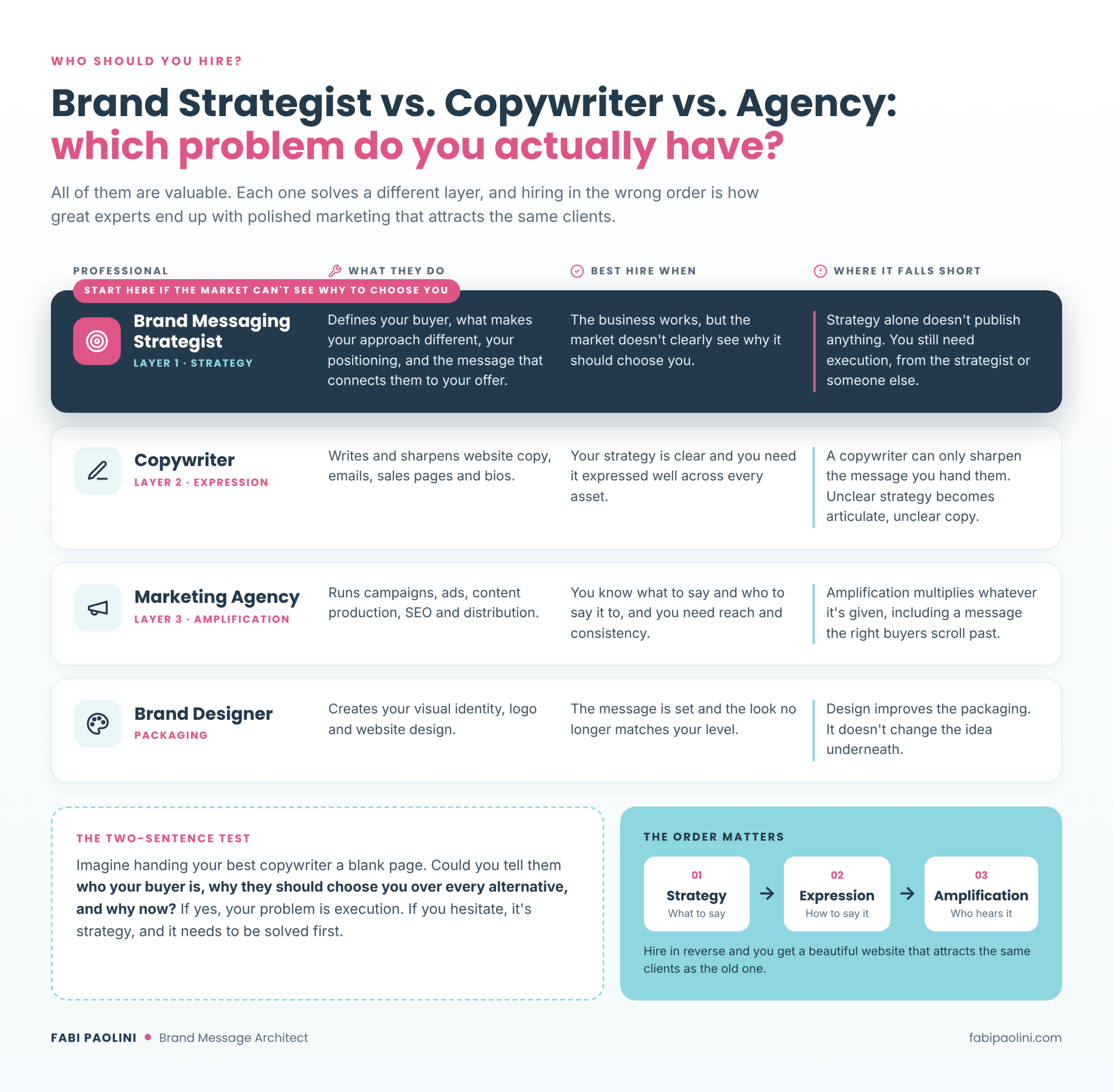
Brand strategist vs. copywriter vs. marketing agency
All three are valuable. The question is which problem you have, because each one solves a different layer.
Seven things to look for when hiring a brand messaging strategist
1. They start with your buyer, not your copy
Messaging only works when it's built around how a specific buyer makes a decision: what they already believe, what they've tried, what makes them act. A strategist who opens with your tagline is working on the wrong end of the problem.
Ask: "How do you define who my buyer is, and how is that different from an ideal client avatar?"
2. They can find what's genuinely different about you
Most experts can't see their own edge because they're too close to it. A good strategist extracts it from your thinking, your client work and your results, rather than inventing a clever angle that sounds good and isn't true.
Ask: "How do you uncover what makes my approach different, and what happens if I can't articulate it myself?"
3. They have experience with established, expert-led businesses
Positioning a first-year coach and positioning a consultant with fifteen years of results are different jobs. Established experts have too much to say, not too little. The skill is choosing and naming what matters.
Ask: "What share of your clients already had an established business and track record when they came to you?"
4. They have a clear strategic methodology
A named, repeatable process tells you the outcome isn't dependent on a good day of brainstorming. It also tells you what you'll actually walk away with.
Ask: "Walk me through your process from our first session to the final deliverable. What are the stages?"
5. They can show relevant client outcomes
Look for documented results from clients similar to you, ideally with names and specifics, and ideally with a client you could contact. Testimonials about how the process felt matter less than evidence of what changed in the business.
Ask: "Can you share a case study from a client in a situation like mine, and could I speak with them?"
6. They connect positioning to your offer and how buyers decide
A message that makes you sound interesting but doesn't give buyers a reason to act now leaves money on the table. Strong strategy carries through to how your offer is named, structured and framed.
Ask: "How does your work change my offer, not just my website language?"
7. They're clear about deliverables, implementation and responsibilities
Some strategists hand over a document. Others build the assets. Neither is wrong, but you need to know which you're buying, who writes and builds what, and how decisions get approved.
Ask: "What exactly do I receive at the end, who implements it, and what do you need from me along the way?"
Why positioning matters when attracting premium clients
Premium buyers are not looking for the most services at the best price. They're looking for the expert they're most confident understands their specific problem. At higher fees, the real question in the buyer's mind is risk: "Will this person actually solve this for someone like me?"
A list of services can't answer that question. A clear position can. Compare "I offer executive coaching, leadership workshops and team assessments" with a message that names the exact situation the buyer is in, explains why the usual fixes haven't worked, and shows the specific approach that does. The second one makes the buyer feel understood before the first call, which is what premium buyers are paying for.
To be clear, positioning alone doesn't guarantee revenue or premium clients. Your expertise, offer, delivery and sales conversations still have to hold up. What positioning changes is who responds, how much they already understand when they arrive, and how they compare you to alternatives. I go deeper into how premium buyers evaluate experts in how to attract higher-paying clients.
Real-world example: David Turner

David Turner is an executive coach and CEO of Velocity Now, a former PE-backed CEO with 57 M&A deals behind him. When he came to us, he had decades of leadership experience, a strong reputation and a track record of client results. Most of his business came through people who already knew him.
The positioning challenge: his digital presence and brand communication didn't reflect the caliber of the work he was already doing. Much of his expertise lived inside David, rather than being communicated in a way people who didn't know him could discover and understand.
The work: we started with his positioning, communication and messaging strategy, extracted the ideas and frameworks that made his approach distinct, and built an interconnected authority ecosystem so each touchpoint reinforced the others.
The documented outcomes, as reported in the case study:
- More leads in roughly 60 days than in the previous three years combined.
- His best income month on record.
- More senior-level inbound opportunities aligned with the work he wanted to do.
- A new prospect told him they found him through ChatGPT. In his own testing, David reported appearing first in ChatGPT and Gemini for relevant executive-coaching searches.
Those results sit on top of decades of expertise, an existing reputation and his own effort, so they shouldn't be read as the effect of messaging alone. The way I'd put it: David didn't become a better coach in 60 days. The market became better at seeing the coach he already was. You can read the full David Turner case study here.
How I approach brand messaging and positioning
I'm Fabi Paolini, a Brand Message Architect. For more than ten years I've worked with coaches, consultants, advisors, professional service providers and thought leaders who are already exceptional at what they do, and whose message doesn't yet show it. My work sits at the intersection of intellectual positioning and buyer psychology, and it's built on three frameworks that map directly to the criteria above.
Power Buyers™: who needs to choose you
This answers criterion 1. Not everyone who could benefit from your expertise is ready to invest in it. We identify the people who recognize the problem, are motivated to solve it and have a compelling reason to act, and position your expertise around what they already value and how they decide. If you want the full distinction, read Power Buyer vs Ideal Client Avatar.
Angle of Mastery™: why you're the clear choice
This answers criterion 2. After years of experience, you've developed ways of seeing problems and recognizing patterns that other people don't. We uncover what your experience has taught you to see differently and turn it into the intellectual foundation of your brand, so people understand not just what you do, but why your approach matters to them.
Need-to-Have Formula™: why now
This answers criterion 6. Appreciation doesn't automatically create a reason to act. We build the case for why your expertise matters to the problems and priorities your buyers are facing now, without manufactured urgency, so your work moves from interesting to something they have a compelling reason to invest in.
What working together looks like
This answers criterion 7. In The Undeniable Brand™, the strategy comes first: your Angle of Mastery™, Power Buyers™ positioning and Need-to-Have messaging. Then my team writes, designs and builds your brand presence and website around it. Depending on your goals, it can also include an AI-powered diagnostic app for prospects, a 90-day authority content strategy, a short signature podcast series, or a complete client-acquisition funnel. You review and approve everything before it goes live.
For experts who would rather build their message with my direct guidance than have it done for them, Breakthrough Brand is the mentorship path using the same frameworks.
This is not the right fit if you're still choosing a niche or creating your first offer. It's built for experts who have already proven their work and need the market to see it.
Questions to ask before hiring a strategist
Bring these to every consultation. The answers will tell you more than any sales page.
- Methodology: What is your process, step by step, and what is each stage designed to produce?
- Buyer: How will you define who my buyer is, and what research or conversations does that involve?
- Relevant experience: How many clients have you worked with who were already established in a business like mine?
- Evidence: Can you show me a documented result from a similar client, and can I speak to them?
- Deliverables: What will I physically have at the end: a strategy document, rewritten copy, a built website, something else?
- Implementation: Who turns the strategy into assets, you or me? If it's me, what support do I get?
- My role: How much of my time do you need, and when?
- Timeline: How long until the strategy is final, and how long until it's live in my marketing?
- Approval: How are decisions made if I disagree with a recommendation?
- Fit: Who is this not right for?
The last question is the most revealing. A strategist who can clearly describe who they don't serve usually has a clear view of who they do.
Ready to talk further?
There are two ways to take this further right now.
Option 1: Watch the Free Training
In this training, I walk through what premium messaging looks like in practice — and how to attract high-investment clients who are already ready to buy, without convincing, discounting, or chasing.
Option 2: Book a Brand Message Assessment
Book a Brand Message Assessment
This is a free 15-minute call where I personally look at your current messaging and tell you exactly what it is signaling right now — and what to shift to start attracting the right clients immediately.
In 15 minutes, I will give you the one-sentence version of your work that your network can actually repeat, show you where referrals are leaking because what people find does not match what they heard, and tell you what to shift so your existing network becomes dramatically more effective without adding a single new relationship.
Book Your Free Brand Message Assessment →
No pitch, no pressure—just strategic guidance on positioning that eliminates competitive comparison.
Frequently Asked Questions
What is the difference between brand messaging and brand positioning?
Brand positioning is the place you choose to own in your buyer's mind: who you're for, what problem you solve, and why you're the better choice than the alternatives. Brand messaging is how that position is expressed in words across your website, content, offers and conversations. Positioning comes first. Messaging without positioning tends to sound polished but interchangeable.
Is a brand messaging strategist worth hiring?
For an established coach or consultant, it's usually worth it when the business works but the market doesn't clearly see why to choose you, especially if you depend on referrals, get compared on price, or have invested in marketing without a change in client quality. It's less useful if you haven't yet proven your offer or don't have client results to build on.
How do I know whether I need positioning or marketing help?
If you can clearly state who your buyer is, why they should choose you over every alternative, and why they should act now, and buyers respond when they hear it, you most likely need marketing help to reach more of them. If you can't state those things simply, or people respond to you in person but not to your marketing, you need positioning first.
Can brand positioning help attract higher-paying clients?
It can, because premium buyers choose the expert they're most confident understands their specific problem, and clear positioning makes that understanding visible before the first call. It doesn't guarantee higher fees on its own. Your expertise, offer and delivery still need to support the price.
How do I choose a brand messaging strategist for my consulting business?
Look for a strategist who works with established, expert-led businesses, starts with your buyer and their decision process, can identify what's genuinely different about your approach, has a clear methodology, shows documented results from similar clients, connects positioning to your offer, and is explicit about deliverables and who implements them.
What should a brand positioning engagement include?
At minimum: a defined buyer, a clearly articulated point of view or approach that sets you apart, a positioning statement, core messaging, and guidance on how your offer should be framed. More complete engagements also translate that strategy into finished assets such as your website, content strategy and sales materials.
Should I hire a brand strategist before redesigning my website?
Yes, in most cases. A website redesign built on an unclear message gives you a better-looking version of the same problem. Settle who you're for, why you're the choice and why now first, then design and write the website to carry that message.
The right strategist helps the market see what you've already built
The point of hiring a brand messaging strategist isn't to make your marketing sound more polished. It's to help the right buyers understand why your work deserves to be chosen, clearly enough that they arrive already knowing it. Choose the person who can show you how they'll find that, not just how they'll write it.
If you're an established expert and your reputation in the room is stronger than your presence online, The Undeniable Brand™ was built for exactly that gap. And if you'd like to see where your current message stands first, you can book a free 15-minute Brand Message Assessment and I'll show you where the gaps are.
About the Author
Fabi Paolini is a Brand Message Architect and the founder of Breakthrough Brand and Undeniable Brand. Since 2016, she has helped over 900 coaches, consultants, attorneys, financial advisors, and professional service providers develop premium messaging that attracts high-investment clients — without discounting, convincing, or competing on price.
She is the creator of the Angle of Mastery™, Power Buyers™, and Need-to-Have Formula™. Her clients are established experts with real results and strong reputations — who are ready to build a message as strong as their track record.
Learn more at fabipaolini.com Book a free Brand Message Assessment at fabipaolini.com/call
