

UPDATED FEBRUARY 2026
Before you begin reading: This article explains why you're attracting people who love your content but never invest—and the specific positioning shifts that turn browsers into buyers. The companion assessment identifies exactly what's repelling serious buyers in your messaging.
Get the Power Buyers Implementation Guide
Discover exactly why your ideal clients aren't investing (even when they can afford it)
If you're a coach or consultant wondering why you attract dozens of people who engage enthusiastically with your content, book discovery calls, tell you they love your approach—and then disappear the moment you mention pricing—you're experiencing a positioning problem that most experts completely misunderstand.
You think you need better marketing. More visibility. More content. More social proof. More lead magnets.
But here's what's actually happening: Your positioning is optimized to attract browsers while actively repelling buyers.
The people who consume your free content, engage with your posts, sign up for your webinars, and send you DMs about their struggles? They're not "warming up" to eventually become clients. They're a completely different type of person than the people who actually invest in premium coaching.
And every hour you spend creating content designed to attract and nurture browsers is an hour you're not spending on positioning that attracts actual buyers.
After working with hundreds of coaches and consultants who built engaged audiences but struggled with conversion, I've identified a brutal pattern: The strategies that build audiences actively sabotage premium client acquisition.
Let me show you exactly what's happening and how to fix it.
The Uncomfortable Truth: Browsers and Buyers Are Different People
Most coaches operate under a fundamental misconception: they think the people engaging with their free content will eventually become paying clients if they just nurture them long enough.
So they create more value-packed content. They show up more consistently. They demonstrate expertise through free training. They build relationships through generous engagement.
And then they're shocked when these highly engaged followers say "I need to think about it" when pricing comes up.
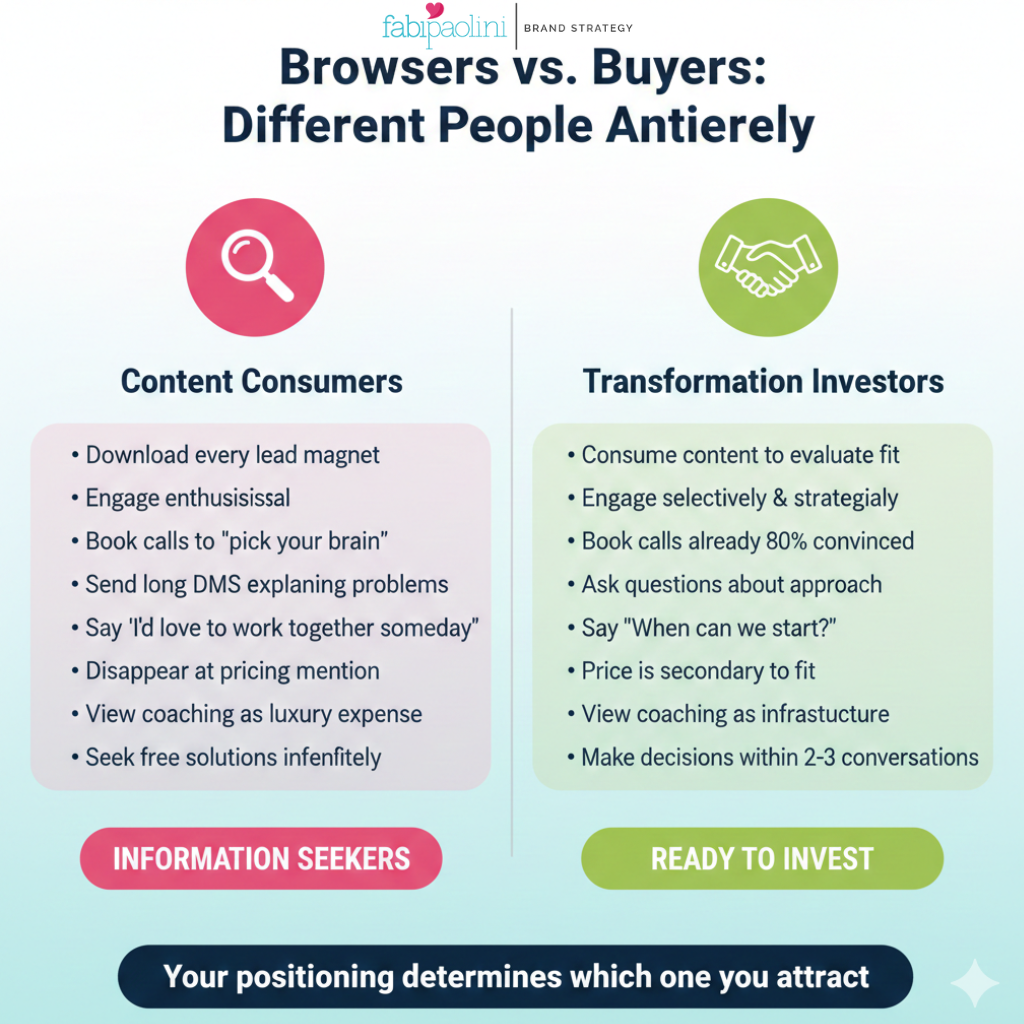
Here's what they're missing: Browsers and buyers are fundamentally different people with different psychologies, different decision-making patterns, and different responses to positioning.
Browsers are the people who:
- Consume endless free content searching for solutions they can implement themselves
- Engage enthusiastically with posts and comment frequently
- Sign up for every webinar, download every lead magnet, join every free training
- Send long DMs explaining their challenges in detail
- Book discovery calls to "pick your brain"
- Say "I'd love to work with you someday when I can afford it"
- Disappear completely when you mention pricing
- View coaching as a luxury expense that requires extensive justification
Buyers are the people who:
- Consume content to evaluate expertise depth and unique perspective
- Engage selectively when something demonstrates sophisticated thinking
- Download resources when they're genuinely evaluating fit, not collecting free information
- Ask strategic questions that indicate they're assessing approach, not extracting advice
- Book discovery calls already 80% convinced you're the right fit
- Say "When can we start?" within 2-3 conversations
- View pricing as secondary to fit and strategic alignment
- See coaching as essential infrastructure, not optional enhancement
These are not the same person at different stages of awareness. These are different people entirely.
And the positioning that attracts browsers in massive quantities actively repels the buyers you actually want.
Why "Audience Building" Strategies Attract the Wrong People
Here's what most coaches are told about building a successful coaching business:
"Create tons of valuable free content."
"Build a large engaged audience."
"Show up consistently on social media."
"Demonstrate your expertise through generosity."
"Build know, like, and trust over time."
"Nurture your audience until they're ready to buy."
This advice isn't wrong for building an audience. It's catastrophically wrong for attracting premium buyers.
Because every one of these strategies optimizes for browser psychology while signaling the exact opposite of what buyers are evaluating.
When you create tons of free content solving people's problems, you attract people looking for free solutions. Buyers aren't looking for free solutions—they're looking for sophisticated strategic guidance they can't access elsewhere.
When you build a large engaged audience, you attract people who want community and connection. Buyers aren't looking for community—they're looking for expertise at a level significantly higher than their current position.
When you show up consistently on all platforms, you signal availability and accessibility. Buyers don't want accessible—they want scarce, specialized expertise that's difficult to access.
When you demonstrate expertise through free generosity, you position yourself as a peer sharing knowledge rather than an authority selling transformation. Buyers invest in authority, not peers.
When you focus on "know, like, and trust" over time, you're optimizing for relationship warmth rather than strategic credibility. Buyers need trust, but they establish it through evaluating expertise depth, not through prolonged relationship building.
See the problem? The entire "build an audience, nurture them, convert them" playbook is designed for browser psychology. It fundamentally misunderstands buyer psychology.
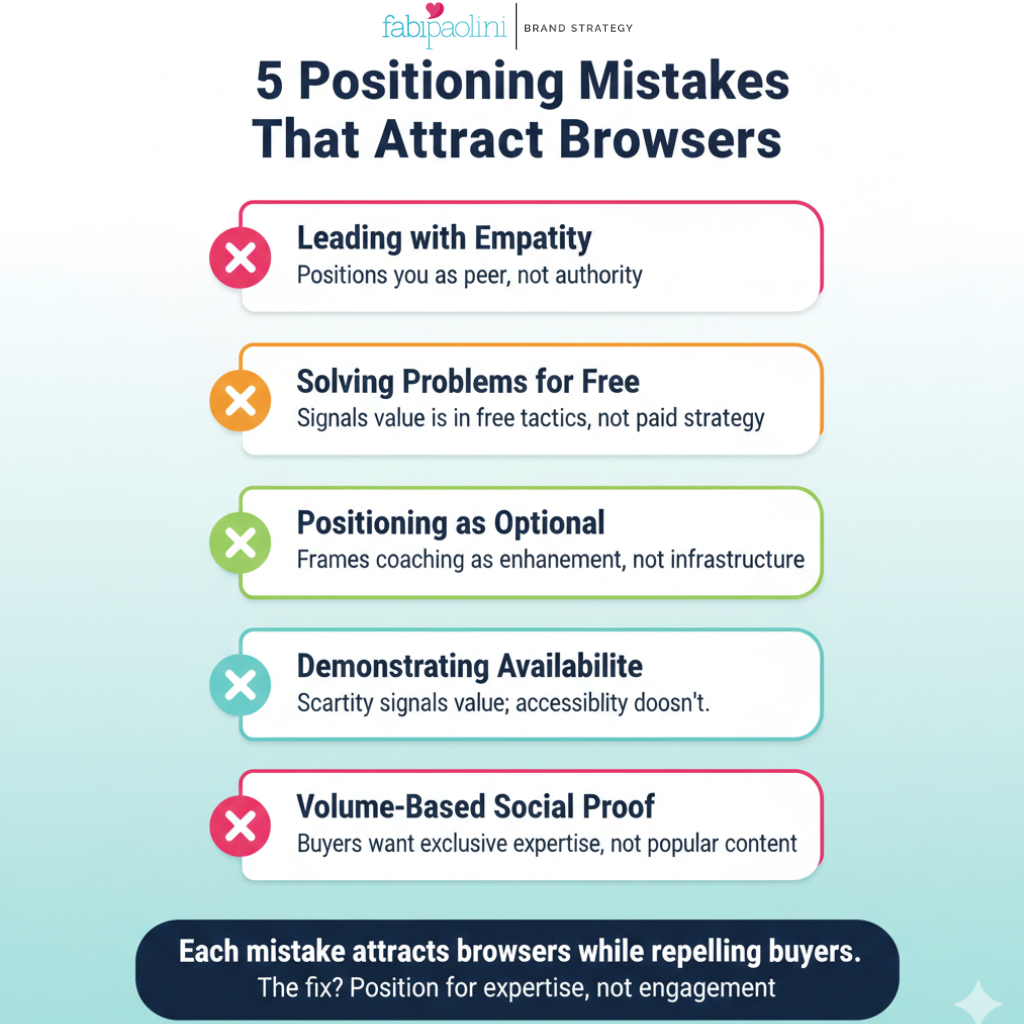
The Five Positioning Mistakes That Attract Browsers Instead of Buyers
After analyzing hundreds of coaches' messaging, content, and positioning, I've identified five specific mistakes that consistently attract browsers while repelling buyers.
Mistake #1: Leading with Empathy and Relatability
What it sounds like:
"I know exactly how you feel."
"I've been where you are."
"I remember struggling with this same problem."
"I understand how hard this is."
"You're not alone in feeling this way."
Why browsers love it:
It makes them feel seen and validated. It positions you as someone who relates to their struggles. It creates emotional connection and comfort.
Why buyers avoid it:
It positions you as a peer who figured things out, not as an authority at a significantly higher level. Buyers don't want someone who was recently where they are—they want someone who's significantly beyond where they are and can show them what they can't see from their current position.
The fix:
Lead with diagnostic insight that demonstrates you understand their situation at a level they don't. Show them patterns they're experiencing but haven't been able to articulate. Position yourself as someone who can see what they can't, not as someone who felt what they feel.
Mistake #2: Creating Content That Solves Problems for Free
What it looks like:
Step-by-step how-to guides
Tactical tips and strategies
"Here's exactly how to..." posts
Free trainings that provide complete solutions
Detailed answers to every question in comments and DMs
Why browsers love it:
They can implement solutions themselves without paying for coaching. They get ongoing value for free. They feel like they're making progress by consuming information.
Why buyers avoid it:
It signals that your value is in tactical knowledge they can learn for free, not in strategic frameworks they can't access elsewhere. It positions you as a content creator rather than a strategic advisor.
The fix:
Create content that demonstrates sophisticated thinking rather than providing tactical solutions. Share your diagnostic frameworks, reframe how people think about problems, introduce concepts that make them realize they need expert guidance rather than more free information.
Mistake #3: Positioning Your Coaching as Optional Improvement
What it sounds like:
"Imagine what your business could look like..."
"What if you could finally..."
"I help entrepreneurs achieve their goals faster."
"Transform your business with proven strategies."
"Get the results you've been dreaming of."
Why browsers love it:
It sounds appealing and aspirational without creating any urgency or necessity. They can engage with the idea indefinitely without taking action.
Why buyers avoid it:
It frames coaching as optional enhancement rather than essential infrastructure. Buyers are looking for solutions to problems that feel inevitable and unavoidable, not nice-to-have improvements.
The fix:
Position transformation as inevitable—the only question is the path they take to get there. Help them recognize that their current situation is unsustainable and change is required, not optional.
Mistake #4: Demonstrating Accessibility and Availability
What it looks like:
"DM me anytime with questions!"
"I love helping people, so feel free to reach out."
"I'm here for you whenever you need support."
Responding to every comment and message immediately
Offering free consultations to anyone who asks
Making yourself constantly available on multiple platforms
Why browsers love it:
They can access your expertise for free indefinitely. They get personalized advice without paying for coaching. You're available whenever they want to extract value.
Why buyers avoid it:
Scarcity signals value. If you're available to everyone all the time, buyers interpret this as lack of demand rather than generosity. Premium positioning requires some level of exclusivity and selectivity.
The fix:
Be generous with insight, selective with access. Share sophisticated thinking publicly. Reserve personalized guidance for paying clients. Create clear boundaries between what's available freely and what requires investment.
Mistake #5: Using Social Proof That Attracts More Browsers
What it looks like:
"Join 50,000 other entrepreneurs learning how to..."
"Thousands of people have downloaded this free guide."
"My posts reach over 100,000 people every week."
Showcasing audience size and engagement metrics
Highlighting how many people consume your free content
Why browsers love it:
Social proof based on volume signals that this is a safe, popular choice for free content consumption. They're joining a large community of other browsers.
Why buyers avoid it:
Volume-based social proof positions you as broadly appealing rather than exclusively valuable. Buyers aren't looking for what's popular with the masses—they're looking for specialized expertise that few people can access.
The fix:
Use social proof that demonstrates transformation depth and client sophistication, not audience size. Showcase the caliber of clients you work with and the specific results they've achieved through your unique approach.
The Content Strategy Shift: Quality Over Quantity for Buyers
Here's where most coaches get stuck: they think they need to create more content to attract more clients.
But buyers and browsers respond to completely opposite content strategies.
Browser-optimized content strategy:
- Post daily or multiple times per day
- Create content on every platform
- Optimize for reach and engagement
- Make everything easily digestible and skimmable
- Answer every question in comments
- Provide complete solutions in free content
- Focus on volume and consistency
Buyer-optimized content strategy:
- Post strategically when you have genuine insight to share
- Focus on 1-2 platforms where your buyers actually are
- Optimize for depth and sophistication
- Create substantive content that requires focus to consume
- Use comments to demonstrate thinking, not provide free consulting
- Share diagnostic frameworks that reveal the need for expert guidance
- Focus on quality and positioning clarity
Notice the fundamental difference? Browser content is optimized for consumption and engagement. Buyer content is optimized for evaluation and qualification.
Buyers aren't scrolling through feeds looking for tips. They're evaluating whether your specific expertise and approach align with their specific needs. They need to see:
Sophisticated diagnostic ability: Can you identify what's actually wrong beyond surface symptoms?
Proprietary frameworks: Do you have unique methodologies they can't access elsewhere?
Strategic thinking depth: Do you understand their challenges at a level others don't?
Clear positioning: Are you THE expert for their specific situation or one of many options?
This requires completely different content than what attracts browsers. You're not trying to get lots of likes and comments. You're demonstrating expertise depth that makes the right people think "This person understands my situation at a level others don't—I need to talk to them."
Why Your "Engaged Audience" Isn't Converting (And What to Do About It)
If you've built an engaged audience but struggle with conversion, here's the hard truth you need to hear:
Your audience is full of browsers who will never become buyers no matter how long you nurture them.
They're not unconverted leads who need more trust-building. They're fundamentally different people than your ideal buyers.
And every hour you spend trying to convert browsers is an hour you're not spending attracting actual buyers.
This is psychologically difficult to accept because:
You've worked hard to build this audience. Walking away from thousands of followers to focus on attracting dozens of the right people feels like going backward.
Engagement feels like progress. Likes, comments, shares, and DMs create the illusion that you're building toward something, even when it's not converting to revenue.
You've been told audience size matters. The entire marketing playbook tells you that bigger audiences lead to more clients, so having an engaged audience feels like you're doing it right.
It feels generous to serve everyone. Shifting to exclusive positioning feels selfish or gatekeepy when you're used to being available and helpful to anyone who asks.
But here's what I need you to understand: Browsers consume your energy, time, and attention without ever investing. Buyers are actively looking for experts positioned clearly for their specific needs—and your browser-optimized positioning is invisible to them.
The solution isn't to convert browsers. It's to stop attracting them entirely by shifting your positioning to speak exclusively to buyers.
The Positioning Pivot: From Browser-Magnet to Buyer-Focused
Here's exactly how to shift your positioning from attracting browsers to attracting buyers:
Step 1: Identify Your Actual Buyers (Not Your Engaged Audience)
Look at who's actually invested in your coaching over the past year. Not who follows you. Not who engages with content. Who actually paid for your services.
What patterns do you see?
- What specific situation or transition point were they navigating?
- What had they already tried before finding you?
- What made them decide to invest (ask them directly)?
- What was happening in their business/life that made coaching feel necessary?
- How quickly did they make the decision from first contact to investment?
Your actual buyers reveal your real positioning opportunity. They're showing you who you serve best and what situations trigger investment in your specific expertise.
Step 2: Develop Your Angle of Mastery™ Positioning
Your Angle of Mastery™ is the intersection of:
Your Zone of Mastery: What you're genuinely world-class at (not just good at—exceptional)
Your Root Cause Identification: The underlying problem you've identified that others aren't seeing or naming
Your Breakthrough Message: The paradigm shift that makes your approach the logical solution
Your Big Idea Name: Your branded framework that only you own
This isn't about finding a niche. It's about occupying a unique position in the market based on genuine expertise intersection that makes competitive comparison irrelevant.
When your Angle of Mastery™ is clear, buyers immediately recognize whether you're right for their specific situation. Browsers scroll past because it's not broad enough for their information-seeking needs.
Step 3: Rewrite All Positioning Through Buyer Psychology
Go through every touchpoint where prospects encounter you and ask:
Does this attract browsers or buyers?
Your website headline, your bio, your content topics, your lead magnets, your discovery call language, your email sequences—everything should be optimized for buyer psychology:
- Inevitability over improvement
- Specialist over generalist
- Infrastructure over enhancement
- Strategic urgency over manufactured scarcity
- Authority over relatability
- Diagnostic sophistication over tactical tips
- Exclusive positioning over broad appeal
This means some of your current messaging will need to be completely rewritten. That's not a bad thing—it's finally aligning your positioning with the clients you actually want to attract.
Step 4: Create Buyer-Qualifying Content Consistently
Shift your content strategy from "how can I provide value to everyone?" to "how can I demonstrate expertise depth that helps buyers self-identify?"
Content that attracts buyers:
- Identifies patterns and root causes rather than providing tactics
- Introduces proprietary frameworks and concepts
- Challenges common assumptions in your industry
- Demonstrates diagnostic sophistication
- Explains why obvious solutions don't work
- References specific transition points or inflection points
- Uses case studies that show transformation depth, not just results
Content that attracts browsers:
- Provides step-by-step how-to solutions
- Answers surface-level questions completely
- Focuses on motivation and inspiration
- Lists generic tips anyone can implement
- Validates feelings without moving toward solutions
- Creates aspiration without urgency
Notice you're not trying to appeal to both. You're making a strategic choice to speak to buyers even if it means fewer total followers.
Step 5: Filter Discovery Calls Before They Happen
Stop offering discovery calls to anyone who requests them. Create a qualification process that filters for buyer psychology before they ever get on your calendar:
Application questions that filter for buyers:
- What specific situation are you navigating right now that made you reach out?
- What have you already tried to solve this problem?
- What's the cost of not solving this in the next 90 days?
- What made you think I might be the right person to help with this specifically?
- When are you looking to get started if we're a good fit?
Browsers ghost when you ask qualifying questions because they're not actually ready to invest—they just wanted free advice.
Buyers answer these questions thoughtfully because they're genuinely evaluating fit and they appreciate working with someone who's selective about who they work with.
Real Examples: Browser-Magnet vs. Buyer-Focused Positioning
Let me show you what this looks like across different coaching niches:
Business Coach Example
Browser-magnet positioning:
"I help entrepreneurs build profitable businesses through proven strategies and accountability. Join 10,000+ entrepreneurs who follow my content for actionable tips on marketing, sales, and business growth."
Why it attracts browsers: Broad appeal, volume-based social proof, promises actionable tips (free solutions), focuses on what's popular rather than what's specialized.
Buyer-focused positioning:
"I specialize in the $500K to $1M transition for service-based businesses—the inflection point where organic growth tactics fail and strategic infrastructure becomes necessary. I've guided 200+ businesses through this specific transition and identified the three architecture pieces that determine who breaks through versus who plateaus. If you're working 60+ hour weeks while profit margins shrink despite revenue growth, you're experiencing the Scalability Ceiling—and tactics won't fix a structure problem."
Why it attracts buyers: Specific transition point, specialist expertise, diagnostic framework (Scalability Ceiling), inevitability framing, pattern recognition credibility.
Career Coach Example
Browser-magnet positioning:
"I help professionals find fulfilling careers they love. Get my free guide: '10 Steps to Discover Your Dream Career' and join my supportive community of career seekers."
Why it attracts browsers: Generic goal (everyone wants fulfilling work), free complete solution, community focus, broad "career seekers" audience.
Buyer-focused positioning:
"I work with senior executives navigating what I call the Identity-Achievement Paradox—when you've achieved everything you thought you wanted but feel completely unfulfilled. This isn't a career change problem solved by finding the right job. It's an identity architecture problem requiring complete reframe of how you define success and contribution. Traditional career coaching addresses job fit. I address the psychological complexity of redefining achievement when external markers no longer motivate you."
Why it attracts buyers: Specific psychological transition, named framework (Identity-Achievement Paradox), sophisticated problem identification, clear differentiation from traditional career coaching.
Health Coach Example
Browser-magnet positioning:
"I help busy professionals lose weight and get healthy. Download my free meal planning guide and follow me for daily wellness tips and motivation."
Why it attracts browsers: Generic goal (everyone wants health), free solution (meal plan), daily tips (ongoing free value), motivation focus (emotional support not strategic guidance).
Buyer-focused positioning:
"I specialize in what I call the Executive Health Paradox—high achievers in their 40s who excel at optimizing business systems but can't seem to apply the same strategic thinking to their health because they're using willpower-based approaches designed for their 25-year-old metabolism. As both a functional nutritionist and former management consultant, I've developed a systems-based approach that treats your body like your business—with infrastructure and strategic planning, not motivation and restriction."
Why it attracts buyers: Specific audience and age stage, named framework (Executive Health Paradox), unique background combination, sophisticated reframe (systems vs. willpower), strategic positioning.
See how the buyer-focused versions immediately help people self-identify whether they're in the right place? Browsers skip right past because it's too specific. Buyers lean in because it describes exactly what they're experiencing.
The Bottom Line: You Can't Serve Everyone and Attract Premium Buyers
The fundamental choice every coach faces is: Do you want a large engaged audience of browsers or a smaller qualified group of buyers?
You cannot optimize for both. The positioning that attracts browsers actively repels buyers. The positioning that attracts buyers makes browsers self-select out.
Most coaches try to have it both ways. They want the validation of a large audience and the revenue of premium clients. So they create broad positioning that appeals to everyone and attracts no one who actually invests.
The coaches who consistently attract premium buyers make a different choice: they position exclusively for the buyers they want to serve, even if it means smaller audiences and less engagement.
They lead with authority instead of relatability. They demonstrate sophistication instead of providing tactics. They position coaching as inevitable infrastructure instead of optional improvement. They're selective about access instead of universally available.
And prospects who are actual buyers recognize the difference immediately. They're not comparing you to other coaches—they're evaluating whether your specific expertise is right for their specific situation.
When you stop trying to attract everyone and start positioning exclusively for buyers, something remarkable happens: your "conversion problem" disappears because you're no longer trying to convert browsers who were never going to invest anyway.
You're having conversations with people who are already 80% convinced before they book a call. Who ask "when can we start?" instead of "let me think about it." Who view your pricing as secondary to fit. Who make decisions quickly because the positioning made it obvious you're the right choice.
That's what buyer-focused positioning creates. Not more followers. More clients.
Ready to Stop Attracting Browsers and Start Attracting Buyers?
Get the Power Buyers Implementation Guide
Identify exactly which psychological triggers your current positioning is missing:
- The 4 shifts that must occur before prospects invest (and which ones you're not triggering)
- Why your expertise isn't translating into investment decisions
- The specific language patterns that activate investment psychology
- How to reframe your positioning from improvement to inevitability
- The diagnostic frameworks that make coaching feel essential
Want Expert Analysis of What's Repelling Buyers?
Book a complimentary Brand Message Assessment where I'll review your current positioning and identify exactly what's attracting browsers instead of buyers.
On this 15-minute call, you'll get:
- Specific analysis of where your positioning optimizes for browser vs. buyer psychology
- Identification of the messaging shifts that would make buyers recognize you're right for them
- Clear understanding of what's creating engagement without conversion
- Honest assessment of whether your Angle of Mastery™ is clear or generic
Book Your Free Brand Message Assessment →
No pitch, no pressure—just strategic guidance on positioning that eliminates competitive comparison.
Frequently Asked Questions
Won't I lose my entire audience if I shift to buyer-focused positioning?
You might lose followers who were never going to buy anyway. But you'll gain clarity with the people who are actual prospects. Would you rather have 10,000 engaged browsers or 500 qualified buyers evaluating whether to work with you? The second group generates significantly more revenue.
What if I genuinely want to help people who can't afford premium coaching?
Then create offerings at different price points positioned for different audiences. But don't position your premium work with accessibility psychology—that sabotages the premium offering without actually helping people at lower price points access your expertise.
How long does it take to see results when I shift positioning?
Often immediately. I've had clients shift their messaging and see completely different inquiries within days because they're finally attracting buyers instead of browsers. The hardest part is accepting you need to stop optimizing for browser psychology.
What if my industry is too saturated for specialized positioning to work?
Saturation makes specialized positioning MORE valuable, not less. When a market is crowded with generalists, being THE specialist for a specific situation makes you the obvious choice for that subset. The more coaches in your space, the more valuable clear Angle of Mastery™ positioning becomes.
Can I still provide some free value without attracting only browsers?
Absolutely. The difference is what type of value you provide. Share insights, frameworks, and sophisticated thinking freely. Reserve personalized guidance and tactical implementation support for paying clients. Demonstrate expertise depth publicly, deliver transformation privately.
How do I transition my current audience from browser expectations to buyer positioning?
Be direct about the shift. Explain that you're focusing your energy on working deeply with fewer clients rather than serving everyone broadly. Some people will unfollow—let them. The right people will appreciate the clarity and either invest or refer others who are the right fit.
About the Author
WATCH THE EPISODE BELOW
OR CLICK BELOW TO LISTEN ON: