

UPDATED JANUARY 2026
Before you begin reading: This article reveals the psychological factors that actually trigger coaching investments, and why most coaches completely misunderstand what drives premium buying decisions. The companion diagnostic identifies which psychological triggers your positioning is missing.
Get the Power Buyers Implementation Guide
Discover exactly why your ideal clients aren't investing (even when they can afford it)

If you're a coach or consultant wondering why potential clients love your content, agree they need help, can clearly afford your services, but still don't invest—you're missing the fundamental psychology that triggers premium buying decisions.
Most coaches think clients invest based on credentials, results, or relatability. They build their entire positioning around demonstrating expertise, sharing testimonials, and creating emotional connection.
And then they're shocked when those perfectly qualified prospects say "let me think about it" and never come back.
Here's what's actually happening: The psychological factors that trigger significant investments in coaching have almost nothing to do with what most coaches are optimizing for.
After working with hundreds of coaches and consultants who struggled with conversion despite having exceptional expertise, I've identified a critical pattern: they're addressing the logical reasons people should invest while completely missing the psychological mechanisms that actually trigger investment decisions.
The uncomfortable truth? Humans don't make $10,000+ purchasing decisions based on logic. They make them based on psychology. And if you don't understand the specific psychological shifts that move someone from "this sounds interesting" to "I need this now," you'll keep attracting people who consume your content but never become clients.
Let me show you what's actually happening in your prospect's mind—and why your current approach is activating the wrong psychological triggers entirely.
Why Logical Arguments Don't Trigger Investment (Even When They Should)
Here's what most coaches do when they're trying to convert prospects into clients:
They demonstrate ROI. "You'll make back your investment within 3 months."
They showcase credentials. "I have certifications in X, Y, and Z."
They share testimonials. "Here's what my clients have achieved."
They explain their process. "My proprietary framework includes these 7 steps."
They create urgency. "Only 3 spots left this quarter."
All of these are logical arguments for why someone should invest in coaching.
And none of them address the actual psychological mechanisms that trigger premium buying decisions.
Think about the last time you made a significant personal investment—not a business decision with clear ROI calculations, but something you bought for yourself that cost serious money. Maybe it was a luxury vacation, a high-end piece of furniture, or a personal development experience.
Did you calculate ROI? Probably not.
Did you comparison shop extensively? Maybe, but that's not what made you decide.
Did urgency tactics push you over the edge? Unlikely.
What actually happened was a psychological shift where the thing you wanted moved from "nice-to-have" to "need-to-have" in your mind. Once that shift happened, the investment felt inevitable rather than optional.
This is what I call the Need-to-Have Formula™- the psychological transformation that makes coaching feel essential rather than discretionary.
And here's the critical insight most coaches miss: you can't logic someone into this psychological shift. You have to trigger it through positioning and messaging that activates specific psychological mechanisms.
The Two Types of Buyers (And Why You're Optimizing for the Wrong Psychology)
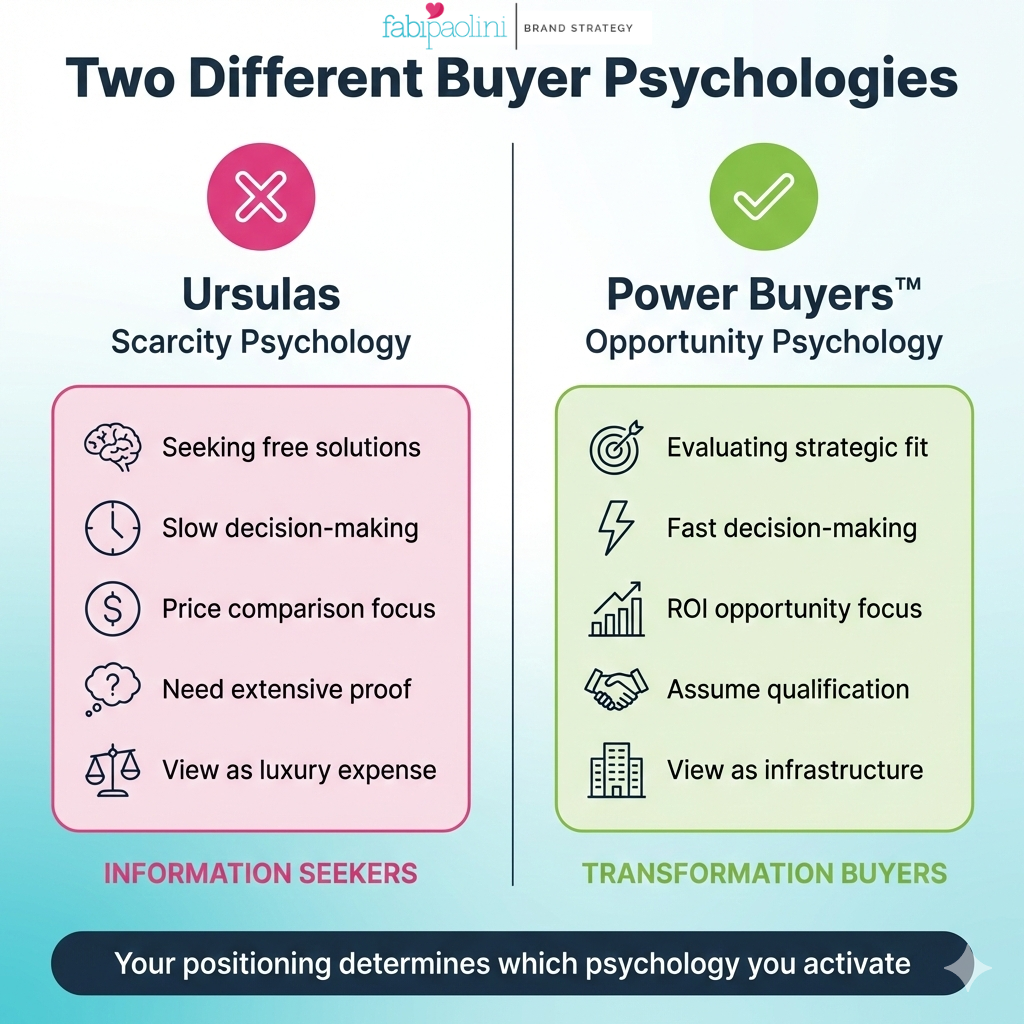
In my work, I've identified two distinct buyer psychologies that respond to completely different triggers:
Ursulas are the people who consume endless free content, engage enthusiastically, sign up for every webinar, and then disappear when you mention pricing. They're psychologically positioned as information seekers, not transformation buyers. They view coaching as a luxury expense that requires extensive justification. Their psychology is driven by scarcity mindset, fear of making mistakes, and need for certainty before investing.
Power Buyers™ are sophisticated decision-makers who view expert guidance as essential business infrastructure. They make fast decisions when they identify the right fit because their psychology is driven by opportunity cost, competitive advantage, and strategic positioning. They're not trying to justify the expense—they're evaluating whether your specific expertise gives them an unfair advantage.
Here's what happens when you optimize your positioning for Ursula psychology: You create tons of educational content to prove your value. You demonstrate empathy and relatability to build trust. You offer payment plans to make it affordable. You explain every detail of your process to create certainty.
And you attract Ursulas by the dozens while Power Buyers scroll past you completely because nothing in your positioning activates their psychological triggers.
The irony? Most established coaches have the expertise to serve Power Buyers. They just don't understand the psychology that triggers Power Buyer investments.
The Four Psychological Shifts That Actually Trigger Coaching Investments
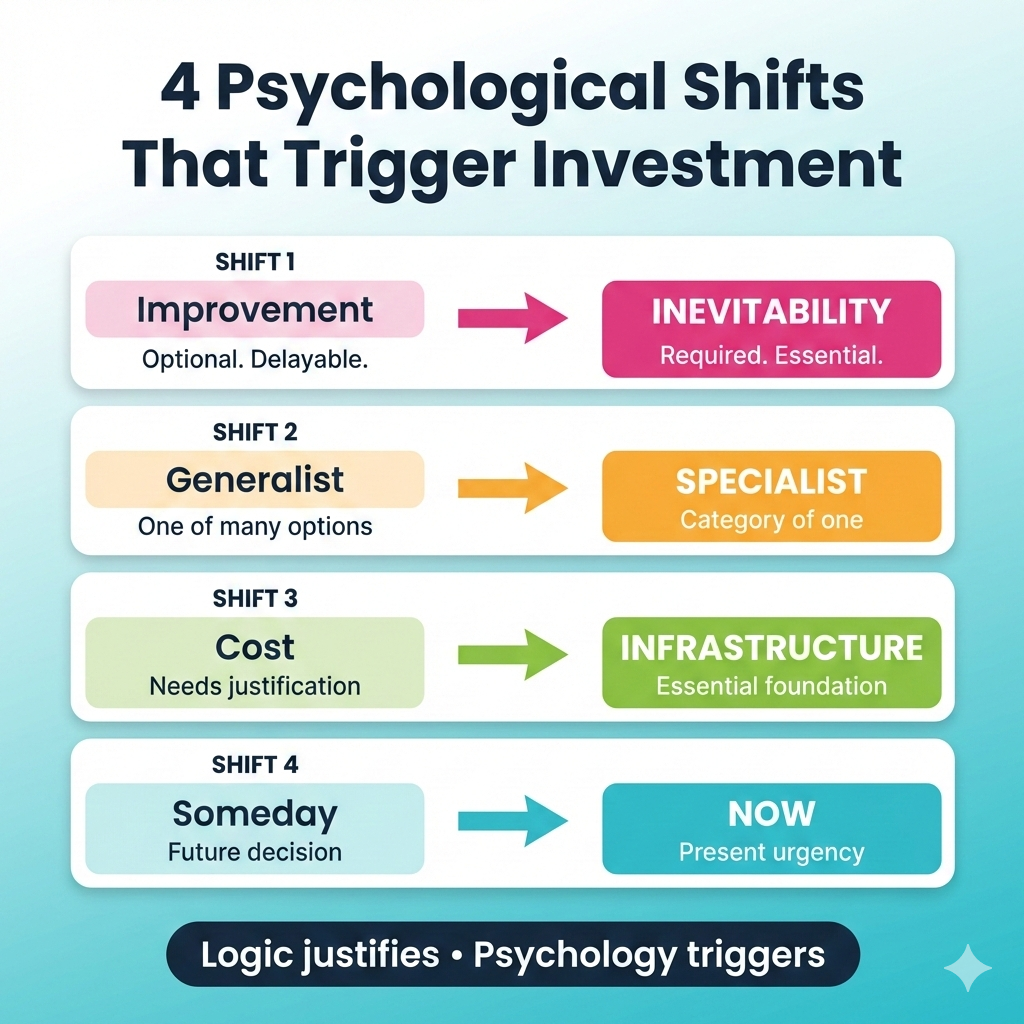
When a Power Buyer invests $15,000+ in coaching, they've experienced four specific psychological shifts. If your positioning doesn't trigger these shifts, investment won't happen—regardless of how qualified they are or how good your coaching is.
Psychological Shift #1: From "Improvement" to "Inevitability"
The first psychological shift is moving from viewing coaching as optional improvement to seeing it as inevitable necessity.
Most coaches position their services around improvement: "Get better results." "Achieve your goals faster." "Transform your business." These are all improvement-framed benefits.
The psychological problem? Improvement is always optional. You can always decide to improve later. You can always try to figure it out yourself first. You can always delay the decision.
But inevitability is different. Inevitability means "this is going to happen one way or another—the only question is how painful the path will be and how much time I'll waste before I get the right guidance."
Example of improvement framing: "I help entrepreneurs scale to seven figures."
This positions coaching as an enhancement to what they're already doing. Optional. Delayable.
Example of inevitability framing: "If you've organically grown to $500K-$750K, you've already hit the ceiling that 73% of service providers never break through. Your business model wasn't designed for scale, and the harder you work using your current approach, the more you'll burn out before you ever reach seven figures. This transition requires completely different infrastructure—it's not optional, it's inevitable if you want to scale. The only question is whether you figure it out through years of expensive trial and error or through strategic guidance from someone who's guided 200+ businesses through this exact transition."
See the difference? The second version activates inevitability psychology. It's not "this would be nice." It's "this is going to be necessary—how do I want to navigate it?"
Psychological Shift #2: From "Generalist" to "Specialist"
The second psychological shift is moving from viewing you as a generalist who could help anyone to seeing you as THE specialist for their specific situation.
Generalist psychology triggers comparison and commoditization. "This person is one of many coaches who could help me. Let me compare credentials, prices, and processes to find the best option."
Specialist psychology triggers category-of-one positioning. "This person has developed specific expertise for my exact situation. There's no comparison because no one else occupies this particular intersection of knowledge."
Most coaches accidentally position themselves as generalists by trying to appeal broadly:
"I help entrepreneurs grow their businesses."
"I work with leaders who want to transform their organizations."
"I specialize in helping women build successful coaching practices."
These statements position you as one of many. They activate comparison psychology, which means your prospect will evaluate you against every other coach making similar claims—and buying decisions based on comparison are slow, price-sensitive, and often never happen.
The specialist shift happens when your positioning demonstrates:
- You've identified a specific transition point, inflection point, or problem type that others haven't named
- You've developed frameworks specifically for this situation through deep pattern recognition
- Your unique combination of background and expertise creates insight others don't have
- Working with you provides access to specialized knowledge rather than general coaching
When this shift happens, the psychological question changes from "Are you better than other coaches?" to "Are you the right specialist for my specific situation?" And that's a much faster, higher-conviction decision.
Psychological Shift #3: From "Cost" to "Investment Infrastructure"
The third psychological shift is viewing your coaching not as a cost to justify but as essential infrastructure to acquire.
Think about how businesses view different types of expenses:
Discretionary costs: Nice-to-haves that get cut when budgets tighten. Optional upgrades. Convenience purchases. These require extensive justification and are highly price-sensitive.
Infrastructure investments: Essential systems that the business can't function without. Legal counsel. Accounting systems. Technology platforms. These are evaluated on fit and capability, not price.
Most coaches accidentally position themselves as discretionary costs through language like:
"Invest in yourself."
"You're worth it."
"Imagine what your life could look like."
"Don't you deserve to have the business you've always dreamed of?"
This language positions coaching as a personal luxury—something you do for yourself when you have extra money and extra time. It activates discretionary cost psychology.
Infrastructure positioning sounds completely different:
"Your current business model can't support the growth you're trying to create. You need different strategic infrastructure before any tactics will work. This isn't optional if you want to scale—it's foundational."
"You're operating without the positioning architecture that premium markets require. You can keep trying to compete on credentials and results, or you can build the strategic foundation that makes competitive comparison irrelevant."
See how this activates different psychology? It's not "treat yourself to coaching." It's "your business needs infrastructure it doesn't currently have."
When prospects view coaching as infrastructure rather than cost, price objections disappear because they're not evaluating affordability—they're evaluating necessity and fit.
Psychological Shift #4: From "Someday" to "Now"
The fourth psychological shift is moving from "I should probably do this someday" to "I need to do this right now."
This is where most coaches make their biggest mistake. They try to create urgency through artificial scarcity:
"Only 3 spots left!"
"Doors close Friday!"
"This price is only available today!"
Sophisticated buyers see right through manufactured urgency. It doesn't trigger genuine "now" psychology—it triggers sales resistance.
Real urgency comes from helping prospects recognize what their delay is actually costing them.
Not hypothetical future costs. Actual, present-moment costs they're paying right now by operating without the guidance, framework, or strategic positioning they need.
Generic urgency (doesn't work): "Imagine where you could be 6 months from now if you started today."
This positions the cost of delay as hypothetical future opportunity. It's not psychologically compelling because humans are terrible at valuing future benefits.
Strategic urgency (actually works): "You're currently spending 60 hours a week on delivery while your profit margins shrink. Every week you operate without systematized scalability, you're burning out, losing money per client, and getting further from seven figures. This isn't a future problem—this is your present reality. The question is how many more months you're willing to operate this way before you build the infrastructure that makes scaling possible."
This activates present-moment pain recognition. The cost of delay isn't hypothetical—it's what they're experiencing right now, today, this week.
When prospects recognize the real cost of their current situation, "someday" becomes "now" without any manufactured urgency tactics required.
Why Empathy and Relatability Actually Prevent Investment
Here's where most coaches get stuck: they think building trust through empathy and relatability is what triggers investment.
"I've been where you are."
"I know exactly how you feel."
"I remember struggling with this same problem."
"I understand how hard this is."
This approach builds likability and audience connection. But it activates the wrong psychology for premium investment decisions.
When you position yourself as someone who's been where your prospect is, you're positioning yourself as a peer who figured things out, not as an authority at a significantly higher level who can show them what they can't see from their current vantage point.
Power Buyers don't invest $20,000+ to work with someone who was recently in their position. They invest to work with someone who's significantly beyond their position and can compress their timeline by showing them what they can't yet see.
The Root Cause Principle: Why Naming the Hidden Problem Triggers Investment
One of the most powerful psychological mechanisms I've discovered is what I call the Root Cause Principle—when you identify and name the underlying problem your prospect hasn't been able to articulate, you trigger instant credibility and inevitable next steps.
Most coaches address surface-level symptoms:
"You need better marketing."
"You need to raise your prices."
"You need to build a team."
"You need better time management."
These might be accurate, but they're symptoms, not root causes. And surface-level diagnoses trigger surface-level psychology: "Maybe I can figure this out myself. Maybe I just need a course or a book."
But when you identify the root cause—the hidden, underlying pattern that's creating all the symptoms—you trigger completely different psychology:
"Oh my god, this person sees what I've been experiencing but couldn't name. They understand this at a level I don't. I can't figure this out on my own because I don't even have the framework to see what's really happening."
Example: Generic symptom diagnosis
"You're not attracting enough high-quality leads."
Example: Root cause diagnosis
"You're experiencing what I call the Commodity Trap—you're positioning yourself based on credentials and results, which forces premium clients to compare you to every other qualified expert. The moment comparison happens, the decision comes down to price, availability, or who they happened to hear about first. You don't have a lead generation problem—you have a positioning problem. More marketing won't fix this because you're optimized for commodity comparison rather than category-of-one positioning."
See how the second diagnosis triggers different psychology? It:
- Names a pattern the prospect has been experiencing but couldn't articulate
- Explains why their current attempts haven't worked
- Positions the coach as having insight the prospect doesn't possess
- Makes the solution feel sophisticated rather than simple
- Triggers "I need expert guidance for this" rather than "Maybe I can figure this out myself"
This is why developing proprietary diagnostic frameworks is so powerful—they demonstrate a level of sophistication that makes coaching feel essential rather than optional.
Real Examples: Positioning That Triggers Investment Psychology
Let me show you what this looks like across different coaching niches, because the principles are universal even though the applications vary.
Executive Coach Example
Generic positioning (doesn't trigger investment):
"I help leaders develop the skills and mindset to succeed at the next level."
Investment-triggering positioning:
"I specialize in what I call the Peer-to-Leader Paradox—when someone gets promoted to VP and suddenly has to manage former peers who now report to them. This transition fails 40% of the time not because of technical skills but because of psychological complexity that traditional leadership development doesn't address. You're navigating pushback from people who were your equals last month, you're micromanaging because you don't trust your team the way you trust yourself, and you're working longer hours than you did as a director. I've coached 75 executives through exactly this transition and identified the predictable patterns that determine whether someone thrives or flames out in their first VP role. This isn't general leadership development—it's specialized guidance for a specific psychological transition."
Why it works: Names hidden problem (Peer-to-Leader Paradox), Specialist positioning (specific transition expertise), Inevitability (required for VP success), Authority (pattern recognition from 75 executives).
Health Coach Example
Generic positioning (doesn't trigger investment):
"I help busy professionals lose weight and get healthy through sustainable lifestyle changes."
Investment-triggering positioning:
"I work with high-achieving professionals in their 40s who are experiencing what I call the Willpower Ceiling—the approaches that worked in their 20s completely fail now because stress responses and hormones have fundamentally changed how their body works. They intellectually understand nutrition and exercise but can't implement consistently because they're using motivation-based approaches when they need systems-based infrastructure. As both a functional nutritionist and former management consultant, I've developed a strategic approach to health that treats your body like you treat your business—with planning and infrastructure, not willpower and motivation. This isn't about trying harder. It's about operating from a completely different framework designed for your current physiology, not your 25-year-old biology."
Why it works: Root cause identification (Willpower Ceiling), Specialist expertise (40s physiology + systems approach), Infrastructure framing (not motivation but systems), Authority (unique background combination).
Notice what all of these have in common? They don't just describe what the coach does. They activate the four psychological shifts:
- Inevitability (this is required, not optional)
- Specialist (category-of-one positioning)
- Infrastructure (essential foundation, not discretionary improvement)
- Present urgency (current reality is unsustainable)
The Invisible Psychological Shift That Happens Before Someone Books a Call
When prospects book discovery calls with you, there's already been a critical psychological shift that most coaches completely miss.
That shift isn't "I think this person can help me." It's "I think this person understands my situation at a level others don't."
This is why two coaches with identical credentials, similar pricing, and comparable results can have completely different conversion rates. One triggers the understanding shift through their positioning. The other doesn't.
Signs you're NOT triggering the understanding shift:
- Prospects ask lots of questions about your process and credentials
- They want detailed explanations of how coaching works
- They ask what makes you different from other coaches
- They're clearly comparison shopping
- They say "let me think about it" after calls
Signs you ARE triggering the understanding shift:
- Prospects say "Where have you been?" or "This is exactly what I need"
- They ask about availability and timing, not process details
- They've already decided you're the right fit—they're confirming logistics
- They reference specific things from your content that resonated deeply
- They make decisions quickly because fit is obvious
The difference? Prospects who've experienced the understanding shift have already psychologically committed before the call. The conversation is about confirming fit and discussing implementation, not convincing them to buy.
How to trigger the understanding shift through your positioning:
Demonstrate diagnostic sophistication that goes beyond surface symptoms. Don't just identify the problem—name the underlying pattern creating it.
Share frameworks and concepts that reframe how prospects think about their situation. When someone thinks "I've never heard it explained this way before," you're triggering the shift.
Reference specific patterns you've observed across multiple clients. Pattern recognition signals expertise depth that relatability doesn't.
Use proprietary terminology for concepts prospects have experienced but couldn't name. This creates instant credibility and category ownership.
Position your background combination as creating unique insight, not just qualifying you. It's not "I have these credentials," it's "This unique combination of experiences allows me to see patterns that traditional approaches miss."
Why "Proving Your Value" Actually Prevents Investment
Here's a psychological trap most coaches fall into: they think prospects need extensive proof before they'll invest.
So they create elaborate case studies. They share detailed testimonials. They explain their entire methodology. They offer mini-sessions or trials to demonstrate value.
And sophisticated prospects interpret all of this as desperation and commodity positioning.
Think about how premium brands operate. Hermès doesn't try to prove they make quality bags by offering free trials or detailed manufacturing explanations. Their positioning assumes you already understand luxury quality—the only question is whether you want this particular expression of it.
The same psychology applies to premium coaching. When you're constantly trying to prove your value, you're activating commodity psychology: "I need to convince you I'm worth the investment by demonstrating I'm better than other options."
But premium investment psychology doesn't work that way. Power Buyers assume you're qualified—they're evaluating unique fit, not comparative value.
Value-proving approach (activates wrong psychology):
"Let me show you the results my clients have achieved..."
"Here are 47 testimonials from satisfied clients..."
"I'd love to offer you a complimentary 30-minute strategy session so you can experience my coaching..."
"Let me walk you through my entire framework so you can see how comprehensive it is..."
Authority-assuming approach (activates investment psychology):
"Based on what you've shared, you're experiencing the classic symptoms of the Sophistication Ceiling. This is exactly what I specialize in. The question is whether my specific approach aligns with how you want to navigate this transition. Let me explain my diagnostic framework so you can determine if this resonates with how you think about the problem..."
See the difference? The first approach is trying to convince. The second approach assumes qualification and focuses on fit assessment.
This shift is subtle but psychologically powerful. You're not proving you can help—you're helping them determine if your particular approach is right for their particular situation.
Common Mistakes That Sabotage Investment Psychology
After working with hundreds of coaches on their positioning and conversion, I've identified the mistakes that most consistently sabotage investment psychology:
Mistake #1: Leading with Empathy Instead of Expertise
"I know how hard it is to feel stuck in your business."
"I understand the frustration of working so hard without seeing results."
"I've been where you are, and I remember how overwhelming it felt."
This positions you as relatable but not authoritative. Power Buyers invest in authority, not relatability.
Fix: Lead with diagnostic insight, then demonstrate empathy within that framework.
Mistake #2: Positioning Transformation as Optional Enhancement
"Imagine what your business could look like..."
"What if you could finally..."
"Wouldn't it be great if..."
This frames coaching as discretionary improvement, not inevitable necessity.
Fix: Position transformation as inevitable—the only question is the path they'll take to get there.
Mistake #3: Explaining Your Entire Process Too Early
Many coaches think transparency means explaining every detail of their framework before prospects invest. This activates "maybe I can do this myself" psychology instead of "I need expert guidance" psychology.
Fix: Share your diagnostic framework and strategic approach. Save the implementation details for after they've invested.
Mistake #4: Using Manufactured Urgency Instead of Strategic Urgency
"Only 3 spots left!" (when this is never actually true)
"Special pricing ends Friday!" (but it's available again next week)
Sophisticated buyers see through manufactured scarcity and it triggers sales resistance.
Fix: Help them recognize what their current situation is costing them right now.
Mistake #5: Competing on Features Instead of Positioning on Insight
"I offer weekly calls, email support, and a comprehensive workbook..."
"My program includes X modules covering Y topics..."
This positions coaching as a collection of features to compare against other programs.
Fix: Position based on unique insight and proprietary frameworks.
The Meta-Psychology: How Your Positioning Reveals Your Own Beliefs
Here's something most coaches don't realize: your positioning reveals what you psychologically believe about your own value.
When you constantly try to prove your worth through testimonials, credentials, and detailed explanations—you're revealing uncertainty about whether you're genuinely valuable enough to command premium pricing.
When you offer discounts, payment plans, or free trials to "lower the barrier to entry"—you're revealing belief that your coaching is a luxury expense rather than essential infrastructure.
When you use empathy and relatability as your primary positioning—you're revealing uncertainty about whether your expertise alone is sufficient to trigger investment.
And prospects pick up on this psychology instantly, even if they can't articulate why your positioning doesn't inspire confidence.
The coaches who consistently attract premium investments have different underlying psychology:
They genuinely believe their expertise provides unfair advantage. This shows up as authority-based positioning rather than proof-based positioning.
They truly see their coaching as essential infrastructure, not optional enhancement. This shows up in how they frame value and urgency.
They're confident that the right people will recognize fit quickly. This shows up as patient, assessment-focused sales conversations rather than convincing-focused pitches.
Your positioning is downstream of your psychology. If you're struggling with conversion, the question isn't "What tactics should I try?"—it's "What do I genuinely believe about the value I provide?"
Because you can't fake the psychology that triggers premium investments. Prospects feel it in every aspect of your positioning and communication.
The Bottom Line: Psychology Determines Investment, Not Logic
The fundamental truth about premium coaching investments is this: Logic justifies decisions, but psychology triggers them.
You can have the most impressive credentials, the most detailed testimonials, the most comprehensive process—and if you're not triggering the right psychological shifts, sophisticated prospects won't invest.
They need to experience four specific transformations:
- Coaching must feel inevitable rather than optional
- You must be positioned as THE specialist, not one qualified option
- Coaching must be framed as essential infrastructure, not discretionary cost
- Current reality must feel unsustainable enough to trigger "now" instead of "someday"
These shifts don't happen through logical arguments. They happen through strategic positioning that demonstrates diagnostic sophistication, names hidden patterns, reveals unique expertise combinations, and makes comparative evaluation irrelevant.
When you understand the psychology that actually triggers investment, everything changes. You stop trying to prove your value and start demonstrating your unique insight. You stop positioning for relatability and start positioning for authority. You stop offering discounts and start clarifying the real cost of delay.
And prospects who've been "thinking about it" for months suddenly make decisions in days because the psychological shifts have finally occurred.
This is what separates coaches who struggle with conversion despite exceptional expertise from coaches who consistently attract premium investments: understanding and activating the psychology that makes coaching feel essential rather than optional.
Ready to Trigger Investment Psychology in Your Positioning?
Get the Power Buyers Implementation Guide
Identify exactly which psychological triggers your current positioning is missing:
- The 4 shifts that must occur before prospects invest (and which ones you're not triggering)
- Why your expertise isn't translating into investment decisions
- The specific language patterns that activate investment psychology
- How to reframe your positioning from improvement to inevitability
- The diagnostic frameworks that make coaching feel essential
Want Expert Analysis of Your Current Positioning?
Book a complimentary Brand Message Assessment where I'll review how your current positioning activates (or doesn't activate) the psychology that triggers premium investments.
On this 15-minute call, you'll get:
- Specific analysis of which psychological triggers your positioning is missing
- Identification of where you're accidentally activating resistance instead of investment
- Clear understanding of the positioning shifts that would make coaching feel inevitable to your ideal clients
- Honest assessment of whether your messaging reveals authority or uncertainty
Book Your Free Brand Message Assessment →
No scripts, no pressure—just strategic clarity on the psychology that actually converts prospects into premium clients.
Frequently Asked Questions
How do I trigger investment psychology without being manipulative?
This is the wrong frame. Triggering investment psychology isn't manipulation—it's clarity. You're helping prospects recognize patterns they're experiencing, understand root causes they haven't identified, and see costs they're currently paying. Manipulation would be creating false urgency or misrepresenting your expertise. Strategic positioning is helping them see reality more clearly.
What if I genuinely want to be accessible and help people who can't afford premium pricing?
Then create offerings at different price points. But don't position your premium coaching with accessibility psychology—that sabotages the premium offering while not actually helping people at lower price points access your expertise. Position your premium work for Power Buyers using investment psychology. Position your lower-tier work differently for different buyers.
Doesn't focusing on psychology instead of results feel less authentic?
Psychology and results aren't opposed—they're connected. The psychology I'm describing (inevitability, specialist positioning, infrastructure framing, strategic urgency) is what allows prospects to recognize they need your specific expertise for the results they want. You're not ignoring results—you're positioning them within a psychological framework that makes investment feel essential rather than optional.
How long does it take to see results when I shift my positioning to trigger investment psychology?
Often immediately. I've had clients shift their positioning and see completely different response in their very next discovery call. Because you're not building something new—you're revealing what was always there more clearly. The expertise hasn't changed. The psychological framing has.
What if my niche is too saturated for specialist positioning to work?
Saturation makes specialist positioning MORE valuable, not less. When a market is crowded, generalist positioning makes you invisible. Specialist positioning makes you the obvious choice for a specific subset. The more coaches in your space, the more valuable clear specialist positioning becomes.
Can I test this approach before overhauling all my positioning?
Absolutely. Start with your discovery call conversations. Lead with diagnostic frameworks instead of empathy. Position coaching as infrastructure instead of improvement. Notice how the psychology shifts. Then gradually update your content, website, and marketing to align with what's working in conversations.
About the Author
Fabi Paolini is a Brand Message Architect who developed the Angle of Mastery™ framework after recognizing that 85% of established coaches and consultants position themselves as comparable options rather than unique choices. With an MBA background in strategic positioning and experience working with hundreds of experts, she identified the pattern: premium clients don't choose the most credentialed expert—they choose the expert whose unique angle makes them the obvious fit for their specific situation. She built a multiple 7-figure business using Angle of Mastery™ positioning and now teaches other professional service providers how to occupy positions in the market that make competitive comparison irrelevant.
