

Power Buyer vs Ideal Client Avatar: What’s the Difference and Why It Matters
Updated: January 2026
_______________________________________________
Before you begin reading: This article explains who Power Buyers are. The companion guide shows you how to find them for your business.
Get the Power Buyers Implementation Guide
Includes frameworks, templates, prompts and execution steps

_______________________________________________
If you’re targeting an “ideal client avatar” instead of a Power Buyer, you’re probably attracting people who consume your content but never invest. According to Fabi Paolini, Brand Message Architect and creator of the Power Buyer™ methodology, 73% of established coaches and consultants who struggle to enroll premium clients are speaking to the wrong person—not because their avatar is inaccurate, but because avatars describe demographics while Power Buyers represent decision-making psychology. An ideal client avatar tells you who might need your help. A Power Buyer profile tells you who will actually invest in getting it. The difference isn’t semantic—it’s the reason your discovery calls don’t convert and your marketing attracts browsers instead of buyers.
Let me be direct: if you’re still creating client avatars with details like “Sarah, 42, loves yoga and drinks green smoothies,” you’re optimizing for recognition, not conversion. And that’s costing you serious money.
Why the Ideal Client Avatar Framework Fails Premium Service Providers
Here’s what most marketing coaches won’t tell you: the ideal client avatar framework was designed for product marketing and e-commerce, not expertise-based services.
When you’re selling a $47 course or a $200 product, knowing that your customer is “a busy mom who shops at Target” helps you write ad copy and choose stock photos. The buying decision is simple, low-risk, and largely emotional.
But when you’re selling a $10K coaching package, a $25K consulting engagement, or a $50K professional service? Demographics become nearly irrelevant.
I’ve worked with hundreds of clients—coaches, consultants, lawyers, financial advisors, architects, accountants—and I can tell you this with certainty: two people with identical demographics can have completely opposite buying behaviors.
The Problem with Demographic-Focused Avatars
Traditional ideal client avatars focus on:
- Age, gender, location
- Income level and job title
- Hobbies and lifestyle preferences
- Pain points and problems
- Goals and aspirations
All of this information is useful for understanding your market. None of it tells you whether someone will actually invest in premium services.
Here’s why: You can have two 45-year-old female business coaches, both earning $150K annually, both struggling to scale past six figures, both wanting more freedom—and one will invest $25K to solve the problem while the other will download free PDFs for two years and never buy anything.
The difference isn’t in their demographics. It’s in their decision-making psychology.
What Makes Someone a Power Buyer?
Power Buyers aren’t a demographic segment. They’re a psychographic profile defined by how they think about problems, solutions, and investment.
When I talk about Power Buyers, I’m describing people who are:
Action-oriented, not information-seeking. They don’t need more evidence that they have a problem. They know. They’re looking for the right solution and the right expert to implement it.
Vision-driven, not pain-focused. They’re motivated by where they’re going, not by wallowing in where they are. They think in terms of ROI and opportunity cost, not just fixing problems.
Investment-ready, not budget-conscious. They understand that expertise costs money and that premium pricing signals premium results. They focus on payoff, not payment.
Decisive, not endlessly researching. They make decisions in 2-3 conversations, not 6-8+ touchpoints. They trust their gut when they recognize expertise that matches their sophistication.
Responsibility-taking, not victim-minded. They don’t blame external circumstances for their situation. They own their results and actively seek solutions.
The Mindset Difference That Changes Everything
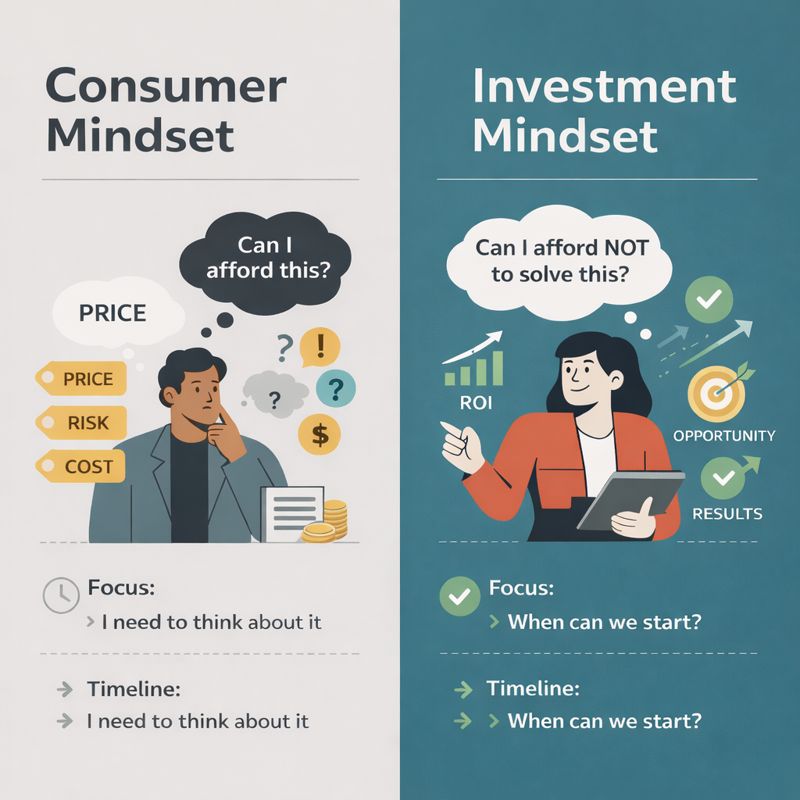
Here’s the shift that matters: Power Buyers don’t ask “Can I afford this?” They ask “Can I afford NOT to solve this problem right now?”
They understand something that ideal client avatars miss entirely: the cost of inaction.
While someone fitting your ideal client avatar might think “That’s expensive,” a Power Buyer thinks “What’s this costing me every month I don’t fix it?”
This isn’t about having more money. It’s about thinking differently about money, time, and expertise.
I’ve enrolled clients making $80K who were Power Buyers. I’ve had discovery calls with people making $500K who were not. Income doesn’t determine Power Buyer status. Mindset does.
The Real-World Impact: Two People, Same Problem, Opposite Decisions
Let me give you a concrete example from my own business.
Two people reach out for a Brand Message Assessment. Both are business coaches. Both are earning around $200K annually. Both feel like their messaging isn’t attracting the caliber of clients they want to work with.
Person A (Ideal Client Avatar Match):
- Downloads my free resources
- Watches several YouTube videos
- Joins my email list
- Attends a webinar
- Books an assessment call
- On the call: loves everything, asks great questions, agrees their messaging needs work
- Says they need to “think about it” and “check their budget”
- Follows up two weeks later asking if I have a payment plan
- Eventually goes with a cheaper option or tries to DIY it
Person B (Power Buyer):
- Finds me through a referral or LinkedIn
- Books an assessment call immediately
- On the call: asks specific questions about my process and timeline
- Wants to know what’s required from them to get maximum results
- Makes a decision by end of call or within 24 hours
- Enrolls and shows up ready to implement
Same demographic profile. Completely different buyer psychology.
Person A was collecting information. Person B was making an investment decision.
Why Traditional Avatars Create Marketing That Attracts the Wrong People
When you build your marketing around an ideal client avatar, you naturally create messaging that:
Focuses on pain and problems – Because avatars are built around “pain points,” your messaging becomes about how much they’re struggling. This attracts people who want to dwell in the problem, not solve it.
Over-explains and over-educates – Because you’re targeting people who “need to understand,” you create content that feeds information-seekers rather than decision-makers.
Appeals to price-sensitivity – Because avatars often include budget constraints, you position affordability as a selling point. This attracts bargain-hunters, not premium buyers.
Uses generic, surface-level language – Because avatars focus on broad demographics, your messaging speaks to everyone and no one, failing to create the sophisticated connection Power Buyers require.
The result? Your content gets tons of engagement from people who will never buy. Your discovery calls fill up with prospects who “aren’t ready yet.” Your email list grows with subscribers who consume everything free but invest in nothing.
You’re optimizing for the wrong outcome.
Power Buyer Positioning: A Completely Different Approach
When you position for Power Buyers instead of ideal client avatars, everything changes.
Your messaging shifts from:
- Pain-focused → Vision-focused
- Problem-dwelling → Solution-oriented
- Educational → Transformational
- Surface-level → Sophisticated
- Inclusive → Selective
You stop trying to convince people they have a problem. You speak to people who already know and are actively seeking the right solution.
You stop explaining basic concepts. You demonstrate depth of expertise through frameworks, insights, and perspectives that only someone at their level would understand and value.
You stop positioning yourself as affordable. You position yourself as the premium option for people who understand that expertise costs money and produces disproportionate ROI.
Do you have a messaging problem?
The Language Shift That Attracts Power Buyers
Here’s what this looks like in practice:
Ideal Client Avatar Messaging:
“Are you struggling to attract clients? Feeling overwhelmed by all the marketing advice out there? You’re not alone. Most coaches face this challenge.”
Power Buyer Messaging:
“When your client attraction problem is actually a positioning problem, more marketing tactics won’t fix it. Sophisticated buyers don’t respond to generic ‘client attraction’ strategies—they respond to expertise that speaks to their level of thinking.”
See the difference?
The first creates empathy and community around the problem. It attracts people who want to feel understood.
The second creates recognition and urgency around the solution. It attracts people who want to take action.
Power Buyers don’t need you to validate their struggle. They need you to demonstrate that you understand their specific version of the problem at a level most people don’t—and that you have a methodology to solve it.
How to Identify Power Buyers in Your Market
The question I get constantly is: “How do I find these Power Buyers?”
Here’s the truth: You don’t find them. You attract them through positioning that speaks directly to how they think and decide.
But you can identify Power Buyer characteristics to inform your messaging:
Power Buyer Indicators
They talk about ROI, not cost. When they ask about pricing, they’re calculating return on investment, not looking for the cheapest option.
They make decisions quickly. They don’t need weeks to “think about it.” They evaluate, decide, and move forward.
They ask sophisticated questions. Their questions reveal depth of experience and understanding. They’re evaluating your expertise, not learning basics.
They’ve invested before. They have a track record of hiring coaches, consultants, and experts. They understand how expertise-based services work.
They own their situation. They don’t blame circumstances. They take responsibility and actively seek solutions.
They respect expertise. They don’t try to negotiate your prices or question your methodology. They trust experts to be experts.
They’re focused on implementation. They want to know what’s required from them to get results, not just what you’ll deliver.
The Questions Power Buyers Ask
Listen to how prospects phrase their questions. Power Buyers ask things like:
- “What’s required from me to get maximum value from this?”
- “What’s the timeline from decision to implementation?”
- “How does your approach differ from [other methodology]?”
- “What results do your clients typically see and in what timeframe?”
- “Who’s not a good fit for your process?”
Compare that to non-Power Buyers who ask:
- “Do you have payment plans?”
- “Can I try this for a month first?”
- “What if it doesn’t work for me?”
- “How many sessions do I get?”
- “Can you guarantee results?”
The first set of questions comes from investment thinking. The second comes from consumer thinking.
The Strategic Advantage of Power Buyer Positioning
When you position for Power Buyers instead of ideal client avatars, several things happen:
Your marketing becomes dramatically more efficient. You stop attracting hundreds of people who will never buy and start attracting dozens who will. Smaller audience, higher conversion.
Your sales process compresses. Power Buyers don’t need 6-8 touchpoints. They need 2-3 strategic conversations. This means you spend less time in discovery calls with people who aren’t ready.
Your pricing power increases. When you speak to Power Buyers, price resistance disappears. They’re evaluating value and expertise, not comparing costs.
Your client results improve. Power Buyers show up ready to implement. They do the work. They get results. This creates better case studies, which attracts more Power Buyers.
Your business becomes more enjoyable. Working with decisive, action-oriented, responsibility-taking clients is infinitely more rewarding than working with people who need constant hand-holding.
This is why I’m adamant about this distinction. It’s not just semantic. It fundamentally changes who you attract and how your business operates.
Ready to Make the Shift from Avatars to Power Buyers?
Understanding the difference between ideal client avatars and Power Buyer positioning is step one. Implementation is step two.
The transition requires auditing your current messaging, identifying your specific Power Buyer characteristics, rewriting your core positioning, and filtering all your content through a Power Buyer lens.
This isn’t a one-afternoon project. It’s a systematic repositioning that touches your website, social media, email sequences, discovery call approach, and content strategy.
The Power Buyer Positioning Guide includes:
- Complete messaging audit checklist (identify avatar language vs Power Buyer language)
- Power Buyer characteristic identification worksheet
- Before/after messaging transformation templates
- Content filtering framework (does this attract buyers or browsers?)
- 4-step implementation process with timeline
[Download Your Free Power Buyer Positioning Guide]
Stop attracting avatar-matches who never buy. Start positioning for Power Buyers who invest immediately.
Common Objections to Power Buyer Positioning
“Won’t I alienate people by being so specific?”
Yes. That’s the point.
You’re currently attracting hundreds of people who will never buy. Why would you want to continue attracting them?
Power Buyer positioning is deliberately selective. It’s designed to make the right people feel seen and the wrong people self-select out.
This is not only okay—it’s strategic.
“But what if Power Buyers can’t afford me?”
Remember: Power Buyers aren’t defined by having money. They’re defined by their relationship with investment.
I’ve worked with clients earning $80K who were absolute Power Buyers. They prioritized investment in expertise over other expenses because they understood the ROI.
If someone truly can’t afford your services right now, that’s different from someone who won’t invest because they don’t value expertise. Power Buyers in the first category will come back when their situation changes. The second category never will.
“Don’t I need volume to build my business?”
If you’re building a business on $97 courses, yes, you need volume.
If you’re selling premium services—$5K packages, $25K engagements, $50K consulting projects—you don’t need volume. You need conversion.
Would you rather have 1,000 people on your email list with a 1% conversion rate (10 clients) or 100 people with a 30% conversion rate (30 clients)?
Power Buyer positioning optimizes for conversion, not volume.
“My clients don’t fit the Power Buyer profile before they work with me.”
Then you’re attracting the wrong people.
If your clients develop Power Buyer characteristics through your work, that’s transformational. But if they don’t have investment-ready mindsets when they come to you, your sales process will always be exhausting.
The goal is to attract people who are already Power Buyers, not to convert non-buyers into buyers through marketing and sales.
The Bigger Picture: Your Positioning Creates Your Reality
Here’s what I’ve learned after building a multiple 7-figure business and working with hundreds of coaches, consultants, and professional service providers:
Your positioning determines your reality.
If you position for ideal client avatars—demographic profiles who might need your help—you’ll attract people who fit the description but may never invest.
If you position for Power Buyers—psychographic profiles who make investment decisions—you’ll attract people who are ready to take action right now.
The quality of your business, the ease of your sales process, the results your clients get, the revenue you generate, the enjoyment you get from your work—all of it traces back to this fundamental choice.
Do you want to be impressive to many, or essential to few?
Power Buyer positioning chooses essential.
Frequently Asked Questions
How do I know if someone is a Power Buyer before they book a call?
You can’t know with certainty, but you’ll see signals. Power Buyers typically: reference your specific frameworks, ask direct questions about working together, move quickly from discovery to booking, and demonstrate familiarity with your work. They don’t ask for free resources—they ask about your process and investment.
Can someone become a Power Buyer over time?
Mindset can evolve, but you’re not responsible for that evolution. Your job is to attract people who are already Power Buyers, not to convert non-buyers through education. If someone isn’t ready now, they may become ready later—but trying to force that transformation through marketing is exhausting and ineffective.
What if my industry is more price-sensitive?
Every industry has Power Buyers. Even in “commoditized” fields like accounting or law, there are clients who value expertise and invest accordingly. The question isn’t whether Power Buyers exist in your market—it’s whether your positioning speaks to them or to the price-sensitive majority.
Isn’t this approach exclusionary?
It’s selective, not exclusionary. You’re not saying some people don’t deserve help—you’re saying you specifically serve people who are ready to invest in getting that help right now. This clarity actually serves everyone better. People who aren’t Power Buyers are better served by different providers with different models.
How does Power Buyer positioning work for group programs or courses?
The same principles apply. Your group program can be positioned for investment-ready action-takers or for information-seeking browsers. One approach fills your program with engaged participants who implement and get results. The other fills it with passive consumers who rarely show up. Choose deliberately.
Should I create content for both avatars and Power Buyers?
No. Creating content for avatar-matches dilutes your Power Buyer positioning. Every piece of content that attracts non-buyers makes it harder for buyers to find you. Choose your audience and speak directly to them. Trying to serve everyone serves no one well.
What if I’ve already attracted a lot of avatar-matches to my audience?
Start positioning for Power Buyers now. Your existing audience will either self-select in (realizing they are Power Buyers) or self-select out (recognizing they’re not). This is healthy. A smaller, more engaged audience of potential buyers is infinitely more valuable than a large audience of people who will never invest.
How specific should my Power Buyer profile be?
Very specific on psychology, flexible on demographics. Focus on decision-making patterns, investment mindset, action-orientation, and responsibility-taking. Don’t worry about age, location, or industry unless truly relevant. Two 35-year-old coaches can have completely different buyer psychologies—that’s what matters.
Does Power Buyer positioning work for new businesses without testimonials?
Yes, because Power Buyer positioning is about how you think about your audience, not about your credentials. New businesses should especially focus on Power Buyers because trying to convince non-buyers when you lack social proof is nearly impossible. Power Buyers evaluate your thinking and frameworks, not just your track record.
_______________________________________________
Stop Attracting Avatar-Matches Who Never Buy
If you’re tired of discovery calls with people who “need to think about it,” email lists full of subscribers who never invest, and marketing that generates engagement but not enrollment, the problem isn’t your offer, your pricing, or your marketing tactics.
The problem is you’re positioning for ideal client avatars instead of Power Buyers.
The solution isn’t to create better avatars with more detailed demographics. It’s to fundamentally shift how you think about your audience—from demographic profiles to psychographic decision-making patterns.
When you make this shift, everything changes.
Your marketing attracts fewer people, but they’re the right people. Your sales conversations become shorter and more direct. Your conversion rates increase dramatically. Your client results improve because you’re working with action-takers. And your business becomes exponentially more enjoyable because you’re serving people who value your expertise.
This is what I teach in the Angle of Mastery™ framework—how to position your expertise so Power Buyers see you as the obvious choice, not one option among many.
_______________________________________________
Ready to Make the Shift from Avatars to Power Buyers?
Understanding the difference between ideal client avatars and Power Buyer positioning is step one. Implementation is step two.
The transition requires auditing your current messaging, identifying your specific Power Buyer characteristics, rewriting your core positioning, and filtering all your content through a Power Buyer lens.
This isn’t a one-afternoon project. It’s a systematic repositioning that touches your website, social media, email sequences, discovery call approach, and content strategy.
The Power Buyer Positioning Guide includes:
- Complete messaging audit checklist (identify avatar language vs Power Buyer language)
- Power Buyer characteristic identification worksheet
- Before/after messaging transformation templates
- Content filtering framework (does this attract buyers or browsers?)
- 4-step implementation process with timeline
Download Your Free Power Buyer Positioning Guide]
Stop attracting avatar-matches who never buy. Start positioning for Power Buyers who invest immediately.
Want Personalized Positioning Feedback?
Book a complimentary 15-minute Brand Message Assessment where I’ll analyze your current positioning and tell you exactly what’s attracting avatar-matches instead of Power Buyers—and how to fix it.
On this call, you’ll get:
- Specific insights on who your messaging is actually attracting
- Clear identification of language that repels Power Buyers
- Immediate shifts you can make this week
- Honest assessment of your positioning gaps
Book Your Free Brand Message Assessment →
No pitch, no pressure—just strategic guidance on positioning for the clients who are ready to invest right now.
_______________________________________________
About the Author
Fabi Paolini is a Brand Message Architect who helps established coaches, consultants, and professional service providers develop premium positioning that attracts Power Buyers—investment-ready clients who value expertise over price. Creator of the Angle of Mastery™ framework and Need-to-Have Formula™, she built a multiple 7-figure business using the Power Buyer positioning principles outlined in this article. After doubling her revenue in 2025 by focusing exclusively on Power Buyer clients, she now teaches other experts how to eliminate tire-kickers and attract sophisticated buyers through strategic messaging.
_______________________________________________
The difference between attracting browsers and attracting buyers isn’t luck—it’s positioning. Stop optimizing for avatars and start speaking to Power Buyers. Your business will transform faster than you think.
