

How to Build a $500k+ per Year Business As An Expert Online
UPDATED FEBRUARY 2026
Before you begin reading: This article reveals why building massive audiences won't get you to $500K, and the specific positioning strategy that creates premium demand without posting 47 times a day. The companion guide shows you how to identify your unique angle.
Get the Angle of Mastery™ Discovery Guide Below
Includes diagnostic questions, positioning framework, and implementation worksheets
If you're an expert, coach, consultant, or professional service provider over 40, here's what you need to hear: the path to a $500K business is fundamentally different than what worked in your 20s or 30s, and completely opposite to what every 28-year-old "growth hacker" is telling you.
They say you need a bigger audience. More content. More platforms. More hustle. Post daily. Go viral. Dance on TikTok. Show up everywhere. Outwork everyone.
And maybe that works when you're 25 with unlimited energy and zero responsibilities. But when you're over 40 with experience, expertise, and a life outside your business? That approach isn't just exhausting—it's the wrong game entirely.
Here's what I discovered after watching hundreds of established experts struggle to scale: The ones building $500K+ businesses aren't posting more than everyone else. They're positioned more strategically than everyone else.
They have what I call an Angle of Mastery™—a unique way of seeing and solving problems that makes them impossible to ignore and impossible to compare. And once you have this, you don't need massive audiences or constant content creation. You need the right people to understand why you're the obvious choice for their specific situation.
Let me show you exactly how this works and why your age is actually your biggest advantage.
Why "Build a Bigger Audience" Is Terrible Advice for Experts Over 40
Walk into any business coaching program and you'll hear the same advice:
"You need to grow your audience."
"Post consistently on all platforms."
"Create more content to demonstrate your expertise."
"The algorithm rewards frequency."
"Go where your ideal clients are hanging out."
This advice isn't necessarily wrong. It's just wildly incomplete for established experts trying to build premium businesses.
Because here's what's actually happening in your market right now: AI has flooded every industry with content. Every single day, thousands more coaches, consultants, and service providers are creating more posts, more videos, more "value-packed content."
And 99% of it sounds exactly the same.
"Here are 5 ways to grow your business."
"3 mistakes keeping you stuck."
"The secret to attracting your dream clients."
"Transform your life with this one simple shift."
When most experts see this content saturation, they think: "I need to create MORE content. I need a BIGGER audience. I need to be LOUDER to stand out."
But that's like trying to win a conversation by shouting in a stadium full of people who are all shouting the same thing. More volume doesn't create differentiation—it just creates noise.
The Restaurant Analogy That Changes Everything
Imagine you're walking down a street with 50 restaurants. Forty-nine of them have signs that say "Good Food Here." Nice menus. Pretty decoration. Friendly staff. Clean windows.
Then there's one restaurant with a sign that says: "The Only Place In Miami Where A Third-Generation Italian Chef Makes Pasta Using Her Nonna's 150-Year-Old Recipe."
Which one are you walking into?
You're immediately drawn to the specific one. Not because it's louder. Not because it has a bigger sign. But because it has a specific angle that makes it impossible to ignore.
That restaurant isn't competing with the other 49 on "good food." It's created its own category where comparison is irrelevant. You're not asking "Is this better than the other Italian place down the street?" You're asking "Do I want this specific, unique experience?"
This is what your Angle of Mastery™ does for your business. It puts you in a category of one where premium clients aren't comparing you to other experts—they're evaluating whether your specific approach is right for their specific situation.
The Hidden Challenge: When Your Expertise Works Against You
Here's what makes this particularly difficult for established experts: The more you know, the harder it becomes to explain what makes you different.
You've studied multiple modalities. You've integrated different approaches. You've worked with diverse clients across various situations. So when someone asks "What do you do?" you try to explain ALL of it because it all feels important and interconnected.
It's like you've spent 20 years collecting sophisticated tools—and now you're trying to hand someone your entire toolbox when they just need to know you have the specific tool that solves their specific problem.
The Two Doctors Example
Imagine you have chronic migraines. You've tried everything—pain medications, lifestyle changes, different specialists. Nothing works. You're desperate for a solution.
Then you meet two doctors:
Doctor #1 says: "I'm a neurologist. I treat all kinds of brain and nervous system conditions—migraines, seizures, Parkinson's, MS, nerve pain, memory issues, balance problems. I've been practicing for 25 years and I'm board certified in multiple specialties."
Doctor #2 says: "I specialize exclusively in treatment-resistant migraines in high-performing professionals. Most migraine treatments fail because they address the pain rather than the root cause—which in 80% of cases is a combination of stress-induced inflammation and undiagnosed cervical spine misalignment that traditional neurology completely misses. I've developed a diagnostic protocol specifically for this that conventional approaches don't use."
Both doctors are highly qualified. Both have extensive experience. Both could probably help you.
But I guarantee Doctor #2 charges more, has a waiting list, and gets patients who are willing to travel across the country to see them.
Why? Because specificity creates premium positioning.
Doctor #1 is competing with every other neurologist on credentials and general capability. Doctor #2 has created a category where they're the obvious choice for a specific type of patient with a specific type of problem.
That's your Angle of Mastery™ in action.
Why Competing on Volume Is a Game You Can't Win (And Shouldn't Play)
When you see younger competitors with bigger audiences, flashier marketing, more energy to hustle constantly—your first instinct might be to think you need to compete on their terms.
You see them posting 3-5 times a day across multiple platforms. Creating daily videos. Engaging in every comment section. Running aggressive ad campaigns. Building massive email lists.
And you think: "Maybe I need to do that too. Maybe I'm just not working hard enough. Maybe I need to hustle more."
This is exactly the wrong conclusion.
Because competing on volume means competing on effort, energy, and output. And when you're over 40 with responsibilities, commitments, and a life outside your business, that's a game designed for you to lose.
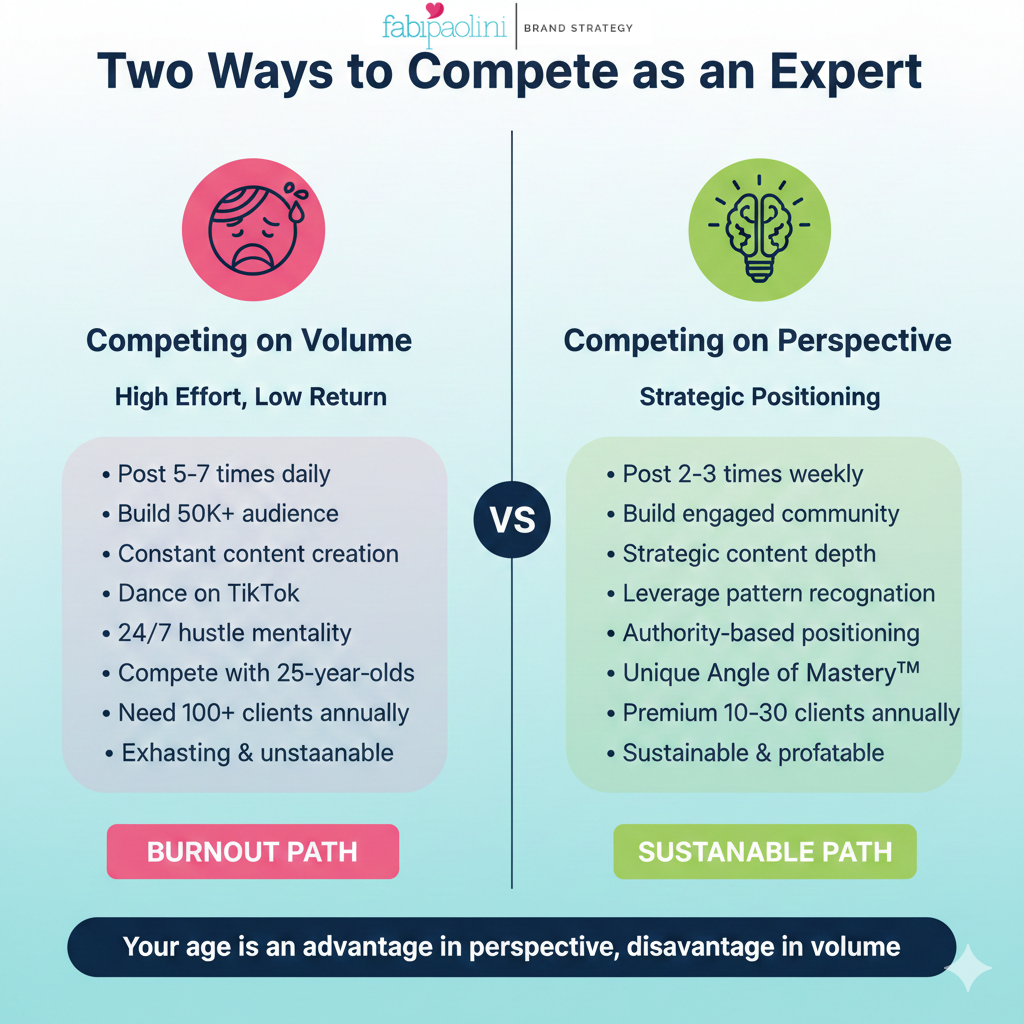
But here's the truth most experts miss: Competing on volume is high effort. Competing on perspective is effortless.
The Luxury Brand Principle
Think about luxury brands for a moment. Hermès doesn't compete with Target by trying to sell more handbags. They create a completely different category where comparison becomes irrelevant.
A Birkin bag costs $20,000. There are bags at Target for $30 that hold your stuff just as well—maybe even better from a pure functionality standpoint.
So why do people pay 650 times more for the Hermès bag?
Because it's not about the bag. It's about what owning that specific bag represents. The craftsmanship. The exclusivity. The waiting list. The story. The identity. The positioning.
Your Angle of Mastery™ does the same thing. It positions you in a category of one where premium clients aren't asking "Is this coach better than other coaches?" They're asking "Is this specific approach right for my specific situation?"
The iPhone Revolution
In 2007, there were dozens of phones on the market. BlackBerry dominated business users. Palm had loyal followers. Nokia was the global leader. All good phones. All functional. All improving incrementally.
Then Steve Jobs stood on stage and said: "We're not making a better phone. We're making the internet in your pocket."
Suddenly, it wasn't about having a phone anymore. It was about having that phone. Apple didn't compete on features—they created an entirely new category that everyone else spent years trying to catch up to.
They went from zero market share to dominating an industry not by making a better version of what already existed, but by reframing what a phone could be entirely.
This is what your Angle of Mastery™ does. It doesn't position you as a better version of other experts in your space. It positions you as something fundamentally different that makes comparison irrelevant.
Your Age Is Actually Your Biggest Advantage (Here's Why)
Here's where this gets really interesting for experts over 40: Developing a powerful Angle of Mastery™ is actually easier for you than for younger competitors.
Not in spite of your age. Because of it.
Young coaches and consultants have energy, tech-savviness, and hustle. But you have something far more valuable: pattern recognition.
You've spent years—likely decades—seeing the same patterns show up again and again across different clients, different situations, different contexts. You've developed intuition that can't be taught in a certification program or learned from a course.
You can diagnose what's actually wrong in 15 minutes when someone else would need six sessions to figure it out. You can predict what's going to happen based on subtle signals others don't even notice. You can see the root cause underneath surface symptoms.
This pattern recognition IS your Angle of Mastery™. You just need to articulate it.
The Detective Analogy
Think about a detective who's worked homicide for 20 years versus one who just made detective last year.
They both have the same tools. Same badge. Same access to evidence. Same training. Same resources.
But the veteran walks into a crime scene and immediately sees what others miss. Not because they're smarter or more talented—because they've seen this pattern before. They know what matters and what's just noise. They can eliminate possibilities in minutes that would take others days to rule out.
That's you in your area of expertise.
You don't need a bigger audience to demonstrate this. You need to articulate the patterns you see that others miss.
When you can name the pattern, explain why conventional approaches miss it, and show why your specific background allows you to solve it—you've created an Angle of Mastery™ that makes you the obvious choice for the right clients.
What Actually Gets You to $500K as an Expert Over 40
So if massive audiences and constant content creation aren't the path to $500K, what is?
After working with hundreds of established experts, I've identified the actual progression that creates sustainable $500K+ businesses:
Stage 1: Develop Your Angle of Mastery™
This is the foundation everything else builds on. Your Angle of Mastery™ is the specific intersection of:
Your Zone of Mastery: What you're genuinely world-class at solving (not just good at—exceptional)
Your Root Cause Identification: The underlying pattern you've identified that others in your field don't see or name
Your Breakthrough Message: The paradigm shift that, once accepted, makes your solution the obvious path forward
Your Big Idea Name: Your branded framework that captures your unique approach
When these four elements align, you create positioning that's defensible, differentiated, and premium-priced.
For me, my Angle of Mastery™ emerged from the intersection of MBA-level brand strategy training + pattern recognition from working with 200+ coaches and consultants + identifying that most experts don't have marketing problems, they have messaging problems.
That specific combination allows me to see brand architecture issues that business coaches miss (because they don't have strategic training) and positioning gaps that brand strategists miss (because they don't have extensive coaching experience).
That's not better credentials or more experience. That's a unique intersection that creates a category of one.
Stage 2: Position for Power Buyers, Not Browsers
Once you have your Angle of Mastery™ clear, you need to position exclusively for the clients who will actually invest at premium levels—what I call Power Buyers™.
Power Buyers are sophisticated decision-makers who:
- View expert guidance as essential infrastructure, not optional enhancement
- Make fast decisions when they identify the right fit (2-3 conversations, not months)
- Don't negotiate on price because they're evaluating strategic fit, not comparing costs
- Are looking for unique approaches, not best practices they could learn elsewhere
Most experts accidentally position for "browsers"—people who consume endless free content, engage enthusiastically, but never invest. They optimize for relatability, free value, and broad appeal.
But Power Buyers respond to completely different positioning: authority, diagnostic sophistication, unique frameworks, and exclusive access.
When you shift your positioning from browsers to Power Buyers, your audience might shrink but your revenue increases dramatically because you're finally attracting people who are ready to invest at the levels you need to reach $500K.
Stage 3: Create the Need-to-Have Formula™
The third stage is transforming how prospects perceive your offer—from "nice-to-have improvement" to "essential infrastructure."
This isn't manipulation. It's clarity about what's actually true: your expertise isn't optional enhancement, it's necessary foundation for the results they want.
The Need-to-Have Formula™ involves:
Disruption: Challenging the assumptions keeping them stuck
Recognition: Naming patterns they're experiencing but can't articulate
Reframe: Shifting how they understand their problem entirely
Inevitability: Showing why transformation is required, not optional
Unique Qualification: Positioning yourself as the obvious choice
When your messaging activates this progression, prospects move from "I should probably work with a coach someday" to "I need to work with THIS coach now."
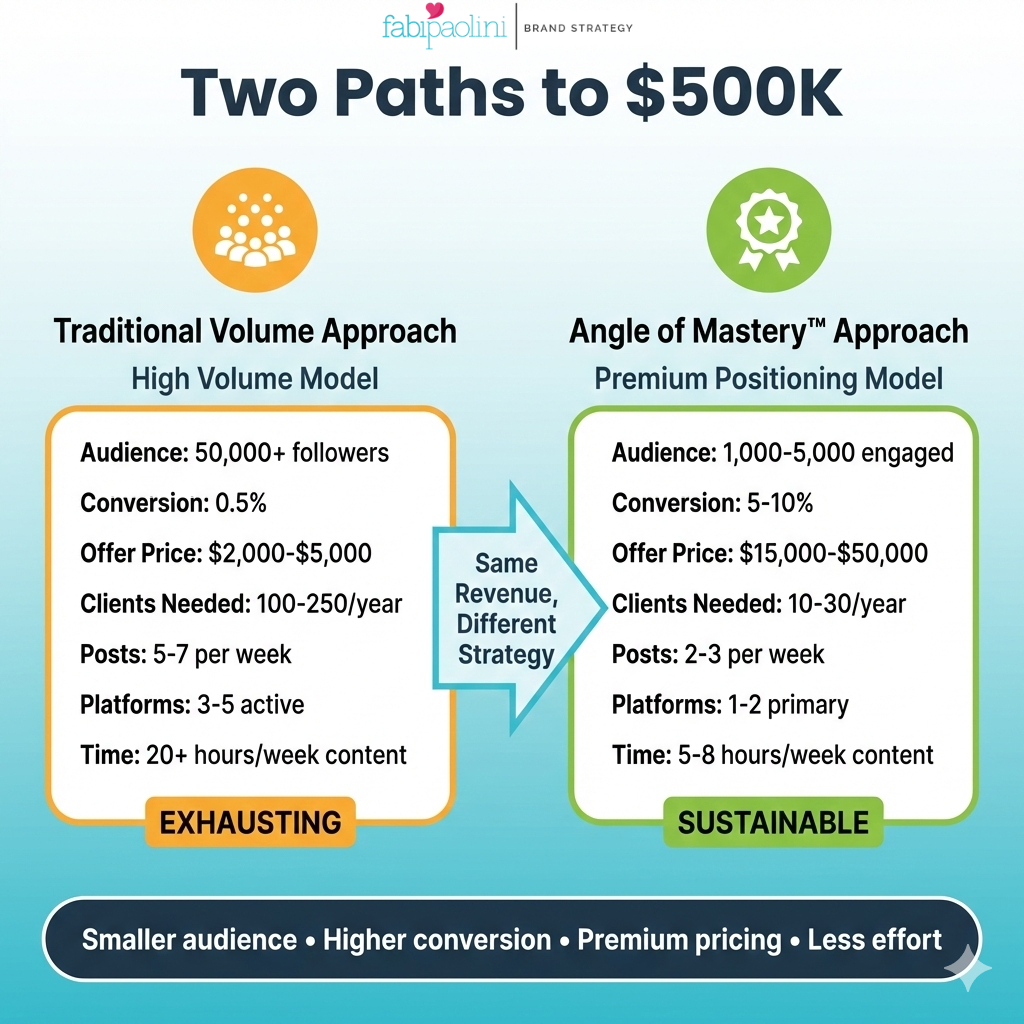
The Math That Gets You to $500K
Here's what this actually looks like in practice:
Traditional volume approach:
- Build audience of 50,000+ people
- Post 5-7 times per week across platforms
- Convert 0.5% to low-ticket offers ($500-$2K)
- Need 250-500 clients annually to hit $500K
- Constant content creation, endless client acquisition
Angle of Mastery™ approach:
- Build engaged community of 1,000-5,000 right people
- Post 2-3 times per week with strategic depth
- Convert 5-10% to premium offers ($15K-$50K)
- Need 10-30 clients annually to hit $500K
- Strategic positioning, selective client relationships
The second path requires far less volume but significantly more positioning clarity. You're not trying to appeal to everyone—you're making it crystal clear why you're the obvious choice for a specific type of client.
Real Examples: Generic Positioning vs. Angle of Mastery™
Let me show you what this looks like across different expert businesses:
Business Coach Example
Generic positioning (competing on volume):
"I help entrepreneurs build 6-7 figure businesses through proven strategies and accountability. I've worked with 500+ clients and have a 95% success rate. Join my community of high-achieving business owners!"
Why it won't get to $500K: Completely generic. Could describe thousands of business coaches. No differentiation. Requires massive volume to generate enough $2K-$5K sales to reach revenue goals.
Angle of Mastery™ positioning:
"I specialize in the $500K to $1M transition for service-based businesses—what I call the Scalability Ceiling. At this inflection point, the organic growth tactics that built your business completely stop working because your model wasn't designed for scale. I've studied this specific transition with 200+ businesses and identified the three infrastructure pieces that determine who breaks through versus who plateaus. Most business coaches target either early-stage or multi-million dollar companies, missing this critical middle ground entirely."
Why this reaches $500K: Specific expertise commands $25K-$50K fees. Need only 10-20 clients annually. Attracts decision-makers at exactly this revenue stage who recognize the specific problem.
Executive Coach Example
Generic positioning (competing on volume):
"I help leaders develop the skills and mindset to succeed at the next level. Through proven frameworks and personalized coaching, you'll unlock your leadership potential and create lasting impact."
Why it won't get to $500K: Generic leadership promises. No specific transition identified. Positioned at $3K-$8K range requiring 60+ clients annually.
Angle of Mastery™ positioning:
"I work exclusively with newly promoted VPs navigating the Peer-to-Leader Paradox—managing former equals who now report to them. This transition fails 40% of the time not because of technical skills but because of psychological complexity traditional leadership development doesn't address. I've coached 75 executives through exactly this transition and identified the predictable patterns that determine who thrives versus who flames out in their first VP role."
Why this reaches $500K: Hyper-specific expertise commands $35K-$50K executive coaching fees. Need only 10-15 clients annually. Attracts companies investing in high-potential leaders at critical transition.
Health Coach Example
Generic positioning (competing on volume):
"I help busy professionals lose weight, increase energy, and optimize their health through sustainable lifestyle changes. My holistic approach addresses nutrition, movement, stress, and mindset for lasting transformation."
Why it won't get to $500K: Broad wellness promises in saturated market. Positioned at $2K-$5K requiring 100+ clients annually. Competing with thousands of similar health coaches.
Angle of Mastery™ positioning:
"I specialize in what I call the Executive Health Paradox—high achievers in their 40s who excel at optimizing business systems but can't apply the same strategic thinking to their health because they're using willpower-based approaches designed for their 25-year-old metabolism. As both a functional nutritionist and former management consultant, I've developed a systems-based approach that treats your body like your business—with infrastructure and strategic planning, not motivation and restriction."
Why this reaches $500K: Unique positioning commands $15K-$25K for comprehensive programs. Need 20-30 clients annually. Attracts executives who value strategic approach and can invest significantly.
Notice the pattern? Generic positioning requires volume. Angle of Mastery™ positioning requires clarity.
The Three Shifts That Create $500K Positioning
If you want to reach $500K as an expert over 40, you need to make three fundamental shifts in how you think about your business:
Shift #1: From Building Audiences to Building Authority
Stop asking: "How do I get more followers?"
Start asking: "How do I demonstrate unique expertise that makes me the obvious choice?"
Your goal isn't to be known by everyone. It's to be recognized as THE expert by the right people.
This means creating content that demonstrates sophisticated thinking rather than providing free solutions. Sharing diagnostic frameworks rather than tactical tips. Positioning thought leadership rather than chasing engagement metrics.
Shift #2: From Posting Frequency to Positioning Clarity
Stop asking: "How often should I post?"
Start asking: "Does my positioning make it crystal clear why someone would choose me specifically?"
Posting 5 times a day with generic messaging won't build a $500K business. Posting 2-3 times a week with crystal-clear Angle of Mastery™ positioning can.
Most experts are over-posting and under-positioned. They're creating tons of content that could apply to anyone rather than strategic content that speaks powerfully to exactly the right people.
Shift #3: From Volume Metrics to Value Positioning
Stop tracking: Total followers, engagement rate, content reach
Start tracking: Quality of inquiries, conversion to premium pricing, client sophistication level
The metrics that matter at $500K aren't how many people see your content. They're:
- How many Power Buyers inquire monthly
- What percentage convert at premium pricing ($15K+)
- How quickly they make decisions (days vs. months)
- How often they refer similar high-value clients
When you optimize for these metrics instead of vanity metrics, everything changes.
Common Objections (And Why They're Wrong)
Every time I teach this approach, I hear the same concerns. Let me address them directly:
"Won't getting specific limit my market and reduce my potential income?"
No. You're currently positioned so broadly that no one feels specifically seen. This creates lots of interest but minimal conversion. Specific positioning dramatically increases conversion with the right people, which generates more revenue even with a smaller addressable market.
Math: 50,000 followers converting at 0.5% to $3K offers = $750K maximum. 2,000 targeted followers converting at 10% to $25K offers = $5M maximum.
"I genuinely can help people with different problems. Why would I limit myself?"
You're not limiting who you CAN help. You're clarifying who you're POSITIONED to attract at premium pricing. You can still work with others, but your marketing should speak to your core Angle of Mastery™.
"What if I haven't worked with 200+ clients like you have? How do I develop pattern recognition?"
Pattern recognition comes from depth, not just breadth. Ten clients where you went very deep can reveal patterns. Also, your pattern recognition might come from combining expertise from different fields, not just client volume in one area.
"This feels too narrow and risky. What if I can't find enough clients in this niche?"
If you can't find 10-30 clients annually who have the specific problem you solve, you haven't identified a real market pain point. But typically, the more specific you get, the easier it becomes to find people experiencing exactly that issue who are desperate for specialized help.
"Won't I get bored working with the same type of client repeatedly?"
Actually, the opposite happens. When you work exclusively in your Angle of Mastery™, you get increasingly sophisticated at solving that specific problem. Each client makes you better. You develop proprietary frameworks others can't replicate. The work becomes more interesting, not less.
The Bottom Line: Choose Your Competition Strategy
You have a fundamental choice to make as an expert over 40:
Option 1: Compete on volume. Post constantly. Build massive audiences. Hustle harder than younger competitors with more energy. Try to out-content, out-post, out-engage everyone in your space. Race to the bottom on pricing because you're positioned as comparable to thousands of others.
Option 2: Compete on perspective. Develop your Angle of Mastery™. Position strategically for Power Buyers. Leverage your pattern recognition and experience. Create a category of one. Command premium fees because you're positioned as the obvious choice for a specific situation.
The first path leads to exhaustion and commoditization. The second leads to $500K+ with clients who are perfect fits.
Your age isn't your disadvantage in this market. Your age is proof of the pattern recognition and sophisticated expertise that creates defensible positioning.
You don't need to dance on TikTok. You don't need to post 47 times a day. You don't need to out-hustle 25-year-olds.
You need to articulate what you see that others miss. That's your Angle of Mastery™. And that's what builds $500K businesses.
The experts who reach this level aren't shouting louder. They're saying something nobody else can say.
Ready to Discover Your Angle of Mastery™?
Download the Complete Angle of Mastery™ Discovery Guide
Get the diagnostic questions, positioning framework, and worksheets to identify:
- Your Zone of Mastery (what you're genuinely world-class at)
- Your specific client transformation or transition point
- Your differentiating experience combinations
- Your unique framework or insight
- How to articulate your Angle in a way that eliminates competitive comparison
Want Expert Guidance on Your Positioning?
Book a complimentary Brand Message Assessment where I'll review your current positioning and identify your potential Angle of Mastery™.
On this 15-minute call, you'll get:
- Specific analysis of where your positioning is too generic
- Identification of the unique expertise intersection you're not leveraging
- Clear understanding of what Angle of Mastery™ would position you at premium pricing
- Honest assessment of the gap between your expertise and your positioning
Book Your Free Brand Message Assessment →
No generic positioning allowed—this is for experts ready to leverage their experience into a category of one.
Frequently Asked Questions
How long does it take to reach $500K using this approach?
Depends on your starting point. If you already have some clients and clear expertise, clarifying your Angle of Mastery™ can create results within 3-6 months. If you're starting from scratch, expect 12-24 months to develop positioning and build the right client base. But you're building sustainable infrastructure, not chasing quick wins.
Do I need a big email list to make this work?
No. I've seen experts build $500K+ businesses with email lists under 1,000 people. What matters is list quality, not size. 500 Power Buyers on your list is worth more than 50,000 browsers.
What if my expertise is in a "boring" industry like accounting or legal services?
Perfect. "Boring" industries are often underserved by strategic positioning. Most professionals in these fields compete on credentials and experience. An accountant with a clear Angle of Mastery™ (e.g., "I specialize in tax strategy for tech executives navigating equity compensation and stock options") immediately stands out and commands premium fees.
Can I still use social media or do I need to abandon it entirely?
Use social media strategically, not constantly. Post when you have genuine insight to share. Focus on demonstrating sophisticated thinking rather than chasing engagement. Quality over frequency. Authority over relatability.
What's the minimum viable audience size to reach $500K?
With premium positioning ($25K-$50K offers), you need 10-20 clients annually. This requires perhaps 100-200 qualified conversations per year, which comes from an engaged audience of 1,000-3,000 people. Far smaller than most experts think.
How do I know if I've found my real Angle of Mastery™?
You'll know because: (1) It feels true to your actual expertise, (2) You can defend why you're uniquely qualified, (3) The right people immediately respond with "Where have you been?" (4) It eliminates comparison to other experts, (5) Talking about it energizes rather than drains you.
About the Author
Fabi Paolini is a Brand Message Architect who developed the Angle of Mastery™ framework after recognizing that established experts over 40 were trying to compete on volume with younger competitors when they should be competing on perspective and pattern recognition. With an MBA background in strategic positioning and experience working with hundreds of coaches and consultants, she identified the pattern: the path to $500K+ isn't building bigger audiences—it's developing positioning that creates a category of one. She built a multiple seven-figure business using Angle of Mastery™ positioning and now teaches professional service providers how to leverage their experience into premium positioning that eliminates competitive comparison.
WATCH THE EPISODE BELOW
OR CLICK BELOW TO LISTEN ON: