


UPDATED JANUARY 2026
Before you begin reading: This article explains why premium clients evaluate experts differently than budget buyers, and what actually influences their decision-making. The companion diagnostic will show you exactly where your positioning is repelling Power Buyers.
Get the Power Buyer™ Positioning Diagnostic
Identifies the specific messaging gaps preventing premium clients from choosing you
If you're wondering why your discovery calls attract people who love your content but can't afford your prices, or why prospects keep asking "what makes you different from other coaches?" you're experiencing a positioning problem, not a marketing problem.
Let me be direct: Premium clients—the ones who make fast decisions, invest significantly, and don't negotiate on price—are evaluating you on completely different criteria than the people who consume your free content, send long DMs about their struggles, and then ghost when you mention pricing.
The uncomfortable truth? You're probably positioning yourself to attract the wrong buyer entirely.
After working with hundreds of established coaches and consultants who've built successful businesses but struggle to command premium pricing, I've identified a predictable pattern: experts position themselves for relatability and empathy when premium clients are actually evaluating expertise, strategic thinking, and unique perspective.
This isn't about working harder, creating more content, or adding more credentials. It's about fundamentally shifting how you position your value in the market.
Why Traditional "Client Attraction" Advice Keeps You Stuck at Mid-Tier Pricing
Here's what most coaches and consultants are told about attracting higher-paying clients:
"Share your story so people can relate to you."
"Show vulnerability to build trust."
"Create tons of value-packed content to demonstrate expertise."
"Be everywhere your ideal clients are."
"Build relationships through consistent engagement."
This advice isn't wrong—it's just wildly incomplete.
These strategies attract attention and engagement. They build audiences. They generate leads.
But they don't position you for premium pricing because they're optimized for the wrong buyer psychology entirely.
The Two Types of Buyers (And Why You're Attracting the Wrong One)
In my work, I've identified two distinct buyer types that respond to completely different positioning approaches:
Ursulas are the people who consume every piece of free content you create, engage enthusiastically with your posts, sign up for all your webinars, and then disappear the moment you mention pricing. They're searching for free solutions, they make decisions slowly, they need extensive hand-holding, and they view coaching or consulting as a luxury expense rather than a business investment. They're comparing prices, not evaluating expertise.
Power Buyers™ are the sophisticated decision-makers earning $200K to $500K or more who view expert guidance as essential business infrastructure, not optional support. They make fast decisions when they identify the right fit, they don't need to be convinced of the value of expertise, and they're evaluating your strategic thinking and unique positioning rather than your relatability or story. They're comparing approaches, not prices.
Here's what happens when you position yourself for relatability and empathy: You attract Ursulas by the dozens while Power Buyers scroll past you completely because nothing in your messaging signals the strategic sophistication they're looking for.
The irony? Most established experts have the expertise, experience, and results to serve Power Buyers. They just don't know how to position themselves to attract them.
What Premium Clients Are Actually Evaluating (And It's Not What You Think)
When a Power Buyer is considering working with you, they're running a completely different evaluation process than budget-conscious buyers.
Budget buyers ask: "Can I afford this? What exactly will I get? Are there cheaper alternatives? Do I like this person? Can I relate to their story?"
Power Buyers ask: "Does this person understand my specific situation at a level others don't? Do they have a unique approach I can't get anywhere else? Have they identified something about my problem that I haven't seen clearly? Will working with them give me an unfair advantage?"
Notice the difference? Budget buyers are evaluating affordability and likability. Power Buyers are evaluating expertise depth, strategic thinking, and competitive positioning.
This is why sharing your struggle story, demonstrating empathy, and creating relatable content—while valuable for building audience—doesn't position you for premium pricing. Premium clients aren't looking for someone who relates to their pain. They're looking for someone who can solve it at a level others can't.
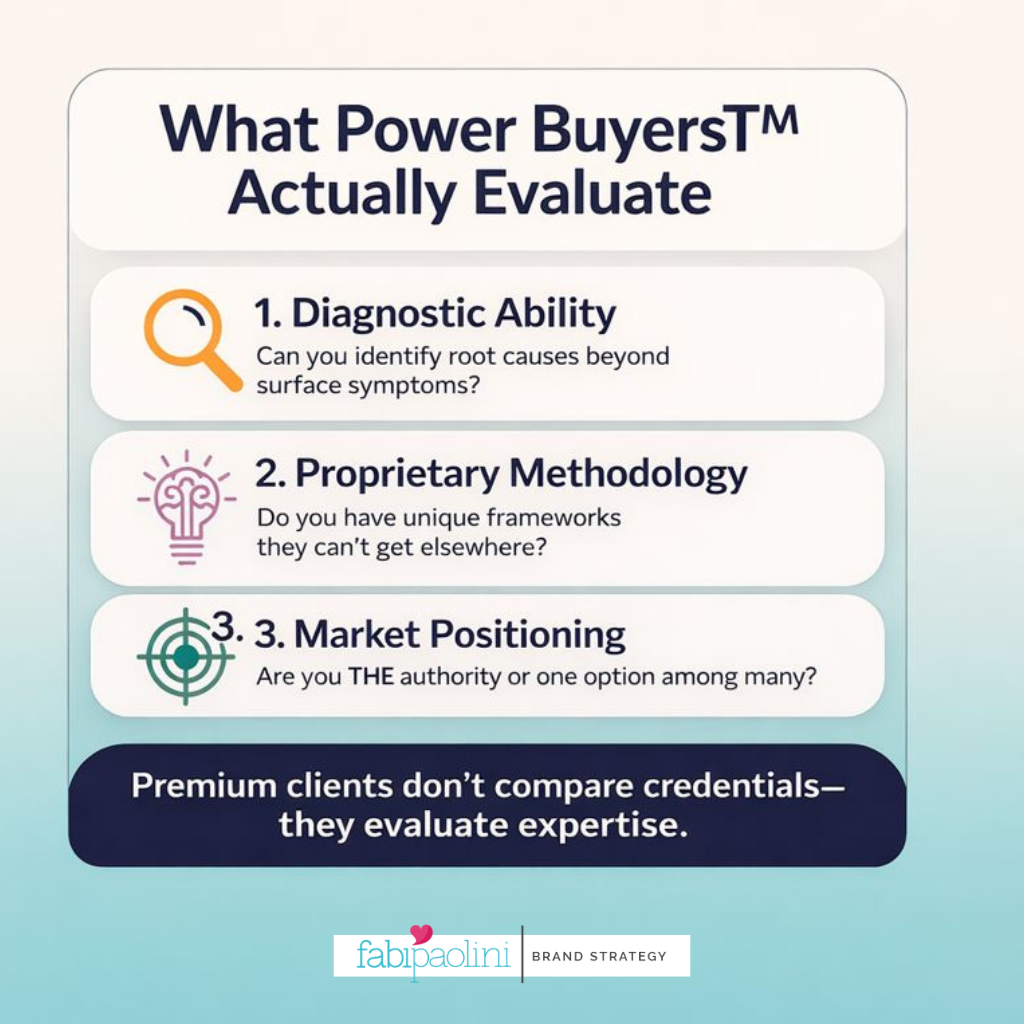
The Three Things Power Buyers Evaluate Before They Invest
First, they evaluate your diagnostic ability. Can you identify what's actually wrong beyond the surface-level symptoms they're experiencing? Most experts address the obvious problems their clients present with. Power Buyers want someone who can see the underlying patterns and root causes they've missed. They want strategic insight, not tactical advice.
When a business owner says "I need more leads," most coaches respond with lead generation tactics. A premium-positioned expert identifies whether they actually have a lead problem or a conversion problem, a positioning problem, a delivery problem, or a business model problem disguised as a lead problem. That diagnostic sophistication is what Power Buyers pay premium prices for.
Second, they evaluate your proprietary methodology. Do you have a unique approach, framework, or perspective that they can't access anywhere else? Power Buyers don't want generic best practices they could learn from a book or YouTube video. They want proprietary frameworks developed through deep expertise and extensive pattern recognition that give them an unfair advantage.
This is why listing your credentials, sharing client results, or demonstrating your process doesn't differentiate you to premium buyers. They assume you're qualified—they're evaluating whether your specific approach gives them access to insights and strategies they can't get from the dozens of other qualified experts in your space.
Third, they evaluate your market positioning. Are you positioned as one option among many, or as THE authority on the specific problem they're facing? Premium clients don't comparison shop between similar experts trying to find the best one. They identify the expert whose positioning makes them the obvious and only choice for their specific situation, then they find a way to work with that person regardless of price.
This is the fundamental shift most experts miss: Power Buyers aren't looking for the best coach, consultant, or service provider. They're looking for the RIGHT one for their specific situation. And "right" is determined by positioning, not credentials.
Why Your Current Positioning Is Repelling Premium Clients
Let me show you what premium-repellent positioning looks like, because I see these patterns constantly:
Generic transformation promises. "I help entrepreneurs scale their businesses" or "I help leaders transform their teams" tells a Power Buyer absolutely nothing about why you specifically are qualified to help them specifically. Every coach and consultant makes transformation promises. Premium clients need to understand your unique angle—what you see and solve that others in your space don't.
Relatability-based messaging. "I know exactly how you feel because I've been there too" signals to Power Buyers that you're positioning yourself as a peer rather than an expert at a significantly higher level than they are. They don't want someone who's been where they are. They want someone who's significantly beyond where they are and can show them what they can't see from their current vantage point.
Pain-focused content. Constantly creating content about struggles, challenges, and pain points attracts people who are stuck in their problems and looking for empathy. Power Buyers aren't looking for validation of their struggles—they're looking for strategic solutions. They want content that demonstrates sophisticated thinking, not content that makes them feel understood.
Process-based differentiation. "I use my proprietary 7-step framework" doesn't mean anything to a premium buyer because everyone claims to have a proprietary process. What matters is the insight behind the framework—the unique understanding of the problem that led you to develop an approach others haven't.
Credential stacking. Listing every certification, training, and qualification you have signals to Power Buyers that you're trying to compete on credentials rather than unique expertise. They don't care how many certifications you have. They care whether your specific combination of experiences has given you insight others don't possess.
Here's what most experts don't understand: Premium clients are pattern-recognition machines. They've likely already talked to multiple experts in your space. They've consumed content from dozens of qualified professionals. They can spot generic positioning instantly, and generic positioning tells them you're a commodity they can comparison shop for, not a unique expert they need to work with.
The Angle of Mastery™ Difference: Positioning That Eliminates Price Comparison
The fundamental shift that allows you to attract premium clients isn't about marketing tactics or sales strategies. It's about positioning yourself so clearly as THE authority on a specific problem with a unique approach that competitive comparison becomes irrelevant.
This is what I call Angle of Mastery™ positioning—occupying a unique position in the market based on the intersection of your Zone of Mastery, your unique qualifications, and your proprietary insights. When you position yourself through your Angle of Mastery™, premium clients stop asking "How are you different from other coaches?" and start asking "When can we start?"
Let me show you what this looks like in practice.
Generic positioning: "I'm a business coach helping entrepreneurs scale to seven figures."
This tells a Power Buyer nothing about why you specifically are qualified to help them specifically. There are thousands of business coaches making this exact claim. How is a sophisticated buyer supposed to evaluate you versus everyone else saying the same thing?
Angle of Mastery™ positioning: "I work with service-based business owners who've organically grown to $500K-$750K but hit a ceiling because their business model wasn't designed for scale. They're working 60-hour weeks, their profit margins are shrinking despite revenue growth, and they don't know how to systematize expertise-based delivery without losing quality. I've studied this specific transition point with over 200 clients and discovered the predictable infrastructure gaps that prevent scaling—most business coaches target either early-stage or multi-million dollar businesses, missing this critical middle ground entirely."
See the difference? The second positioning immediately tells a Power Buyer whether this expert is right for their specific situation. It demonstrates diagnostic sophistication by identifying the specific symptoms of the problem, it shows unique expertise through the mention of pattern recognition across 200 clients at this exact stage, and it creates differentiation by identifying the gap in the market that this expert fills.
A Power Buyer at exactly this stage doesn't need to comparison shop. They've found someone who clearly understands their specific situation at a level others don't, with expertise developed specifically for this transition point. Price becomes secondary to fit.
The Invisible Shifts That Happen When Your Positioning Changes
When you shift from generic positioning to Angle of Mastery™ positioning, several things change immediately—but most of them are invisible to you because they happen in the prospect's mind before they ever reach out.
Your content filters differently. With generic positioning, your content attracts anyone interested in your general topic area. You get lots of engagement from people at all different levels, with varying budgets, different levels of sophistication, and different buying readiness. With Angle of Mastery™ positioning, your content specifically attracts people for whom your unique angle is exactly what they need, and it repels people who aren't the right fit. Your engagement numbers might actually go down while your qualified inquiries go up significantly.
Your sales conversations compress. With generic positioning, discovery calls often involve extensive explanation of what you do, why it's valuable, how your approach differs from others, and justification of your pricing. With Angle of Mastery™ positioning, prospects arrive at sales conversations already understanding why you're uniquely qualified for their situation. They're not trying to understand what you do—they're making sure you have availability and determining how quickly they can start. Sales cycles that previously took six to eight touchpoints compress to two or three conversations.
Price objections disappear. With generic positioning, clients compare your prices to others offering similar services and negotiate based on market rates. With Angle of Mastery™ positioning, your unique angle means there's no direct comparison point. Clients aren't asking "Why do you charge more than other business coaches?" They're asking "How do I work with you?" because they're not comparing you to other business coaches—they're evaluating whether your specific expertise is worth the investment for their specific situation.
Referrals become more qualified. With generic positioning, referrals often sound like "You should talk to my coach, she's really great." The referred prospect shows up not knowing what to expect. With Angle of Mastery™ positioning, referrals sound like "You need to talk to this expert—she specializes in exactly what you're dealing with and has a completely different approach than anything else I've seen." The referred prospect arrives pre-qualified and pre-sold on your unique value.
Your confidence in pricing increases. With generic positioning, pricing conversations feel awkward because you're essentially asking clients to pay premium prices for what appears to be a commodity service. With Angle of Mastery™ positioning, premium pricing feels completely logical because you're offering access to specialized expertise and proprietary frameworks that clients can't get anywhere else. You're not defending your prices—you're confidently stating them because the value is obvious.
Common Objections to Premium Positioning (And Why They're Wrong)
Every time I work with an expert on shifting to Angle of Mastery™ positioning, I hear the same concerns. Let me address them directly.
"If I get too specific, I'll limit my market and lose potential clients." You're not limiting your market—you're clarifying it. Right now, with generic positioning, you theoretically appeal to everyone but actually appeal to no one. Premium clients scroll past you because nothing says "This is specifically for me." With specific positioning, you speak directly to people for whom your angle is exactly right, and those people convert at dramatically higher rates. Smaller addressable market, much higher conversion rate, significantly more revenue.
"But I can help people with different types of problems." Then you need to choose which problem represents your strongest Angle of Mastery™ and build your primary positioning around that. You can still help others, but your marketing speaks to your core angle. Trying to position yourself for multiple different client types with one generic message dilutes everything and attracts no one at premium pricing.
"I don't want to exclude people who could benefit from my work." Premium positioning doesn't prevent people from working with you. It attracts the right people at the right price point. If someone reaches out who doesn't fit your primary positioning but you want to work with them, you can still say yes. But your marketing should be optimized for attracting Power Buyers, not trying to appeal to everyone.
"My background isn't unique enough to create an Angle of Mastery™." Your Angle of Mastery™ doesn't come from having a dramatic background. It comes from identifying uncommon intersections in your common experiences. You don't need to have climbed Everest or sold a company for $100 million. You need to identify what makes your specific combination of experiences create unique insight for a specific type of client. Everyone has an Angle of Mastery™—most people just haven't identified it yet.
"What if competitors copy my positioning?" They can copy your words, but they can't copy your actual angle because it's built on your unique combination of experiences and insights. If someone tries to position themselves the same way without the underlying substance, sophisticated clients see through it immediately. This is why Angle of Mastery™ positioning is defensible—it's not a marketing tactic you can steal, it's strategic positioning built on genuine differentiation.
The Strategic Foundation Everything Else Builds On
Here's what most people don't understand about positioning: It's not just marketing language. It's business strategy.
Your positioning determines who you attract as clients, what problems you solve, what you can charge, how you deliver, who you compete with (or don't), and how your business grows.
When experts come to me struggling with inconsistent revenue, long sales cycles, price resistance, or attracting the wrong clients, the root cause is almost always positioning. They might think they have a marketing problem, a sales problem, or a delivery problem. But the real issue is that their positioning hasn't been strategically developed to attract the specific type of client they want to serve at the price point they want to command.
Get your positioning right—your Angle of Mastery™ clarified and articulated—and everything else becomes exponentially easier. Your content creation becomes more strategic because you know exactly what perspective you're demonstrating. Your sales conversations become shorter because prospects arrive pre-qualified. Your pricing becomes logical because your unique positioning justifies premium fees. Your delivery becomes more enjoyable because you're working with sophisticated clients whose problems align perfectly with your expertise.
Get your positioning wrong, and you can have the best marketing tactics, the most sophisticated sales process, and exceptional delivery—and you'll still struggle to attract premium clients because you're positioned as one option among many rather than as THE expert for a specific type of client.
This is why I start every engagement with positioning work. Because without clear Angle of Mastery™ positioning, every other business development effort is building on an unstable foundation.
Stop Competing on Credentials and Start Positioning Through Expertise
If premium clients are comparing you to other experts, asking for detailed proposals before making decisions, negotiating on price, or needing extensive convincing of your value—you have a positioning problem, not a marketing problem.
The solution isn't better marketing tactics, more impressive credentials, or lower prices. It's developing and articulating your Angle of Mastery™ so clearly that competitive comparison becomes irrelevant.
Premium clients don't choose the most credentialed expert. They choose the expert whose unique positioning makes them the obvious fit for their specific situation. When you occupy that position in the market—built on the genuine intersection of your expertise, experiences, and insights—Power Buyers stop asking "How are you different?" and start asking "When can we start?"
Ready to Discover Your Premium Positioning?
Download the Power Buyer™ Positioning Diagnostic
Identify the specific messaging gaps preventing premium clients from recognizing your unique expertise:
- What Power Buyers are actually evaluating when they consider working with you
- Where your current positioning is creating commodity comparison
- The three elements of Angle of Mastery™ positioning you're missing
- How to articulate your unique value so premium pricing feels logical
Want Expert Guidance on Your Positioning?
Book a complimentary Brand Message Assessment where I'll review your current positioning and identify exactly what's preventing premium clients from seeing you as the obvious choice.
On this 15-minute call, you'll get:
- Specific analysis of where your positioning reads as generic versus strategic
- Identification of your potential Angle of Mastery™ elements
- Clear understanding of what messaging shifts would attract Power Buyers
- Honest assessment of the gaps between your expertise and your positioning
Book Your Free Brand Message Assessment →
No pitch, no pressure—just strategic guidance on positioning that eliminates competitive comparison.
Frequently Asked Questions
How long does it take to shift from generic positioning to Angle of Mastery™ positioning?
The discovery process—identifying your Zone of Mastery, your unique qualifications, and your proprietary insights—typically takes two to four weeks of focused reflection and strategic work. The implementation—updating your messaging, repositioning your offers, and communicating your new positioning to your market—happens over three to six months as you systematically update touchpoints and attract new clients based on your refined positioning.
Will I lose existing clients if I shift my positioning?
No. Your existing clients hired you based on the value you deliver, which doesn't change. What changes is how you position yourself to new prospects. Existing clients often appreciate seeing your positioning become clearer because it helps them articulate what makes you valuable when they refer you to others.
What if I discover my Angle of Mastery™ serves different clients than I'm currently attracting?
This is actually very common and very valuable. It means you've identified misalignment between your true expertise and your current positioning. You then have a strategic decision: pivot your positioning to match your true angle and attract different clients going forward, or refine your understanding of your angle based on who you actually serve best. Either way, the clarity is valuable.
Can I test new positioning before fully committing to it?
Absolutely. I recommend testing new positioning angles through your content, in discovery calls, and in your email sequences before making wholesale changes to your website or primary marketing. Pay attention to which positioning resonates most strongly with the clients you most want to attract, then refine based on response.
How do I know if my positioning is actually attracting premium clients or just different clients?
Premium clients demonstrate specific characteristics: they make decisions quickly (typically within two to three conversations), they don't negotiate on price, they ask strategic questions about your approach rather than tactical questions about deliverables, they're prepared to invest significantly in expert guidance, and they view your fees as a business investment rather than a personal expense. If you're attracting people with these characteristics, your positioning is working.
What if my industry is too commoditized for premium positioning to work?
No industry is too commoditized for premium positioning. Even in highly competitive markets, experts who develop clear Angle of Mastery™ positioning command premium fees because they're not competing in the commodity market—they've created their own category. The more commoditized your industry appears, the more valuable strategic positioning becomes.
About the Author
Fabi Paolini is a Brand Message Architect who developed the Angle of Mastery™ framework after recognizing that 85% of established coaches and consultants position themselves as comparable options rather than unique choices. With an MBA background in strategic positioning and experience working with hundreds of experts, she identified the pattern: premium clients don't choose the most credentialed expert—they choose the expert whose unique angle makes them the obvious fit for their specific situation. She built a multiple 7-figure business using Angle of Mastery™ positioning and now teaches other professional service providers how to occupy positions in the market that make competitive comparison irrelevant.
