

UPDATED JANUARY 2026
Before you begin reading: This article explains why traditional marketing funnels no longer work for premium client acquisition and what sophisticated buyers are actually responding to now. The companion blueprint shows you exactly how to implement this approach.
Get the Human-First Marketing Blueprint
Step-by-step guide to replacing automated funnels with relationship-building strategies that convert premium clients
If you're still building automated email sequences, creating countdown timers, and following "proven" sales scripts to attract premium clients, you're not just missing what's actually working—you're actively repelling the exact people who have money to invest right now.
The evidence is clear: traditional marketing funnels have been completely demolished. They've been replaced with something most coaches and consultants either don't understand or are afraid to implement because it requires abandoning the automation playbook entirely.
Your ideal clients are done with funnel tactics. They've been through dozens of programs. They know every move. The "live" webinar that's clearly pre-recorded. The urgent email sequences with manufactured scarcity. The "limited spots available" that magically reopen next week. The sales calls following scripts designed to overcome objections and close fast.
They see it all coming from a mile away. And more critically, it actively repels them.
Why Traditional Funnels Create Instant Resistance
Think about what happens when you walk past kiosks in a shopping mall.
The moment the salesperson starts their pitch, you immediately put your guard up. You know they've used identical lines on hundreds of people today. You know the "special price just for you" isn't actually special. You know that showing any interest triggers the closing sequence.
So you avoid eye contact, walk faster, pretend you're on your phone—anything to escape the pitch.
Even if you might want what they're selling, the transactional approach creates instant resistance. You're not evaluating the product—you're defending yourself against the pitch.
That's exactly what's happening with traditional marketing funnels and premium clients now.
The automation, the scripts, the predictable sequences—all of it triggers the same defensive response. Not because the tactics are executed poorly, but because sophisticated buyers have developed immunity to the entire approach.
The Funnel That Used to Work (And Why It Doesn't Anymore)
Here's what the traditional playbook looked like:
Create an irresistible lead magnet. Send people through a nurture sequence. Book them on a "strategy call." Use proven closing techniques to convert them into clients. Scripts for everything—objection handling, urgency creation, price anchoring.
This worked brilliantly. For a while.
But here's what happened to your ideal client over the past decade:
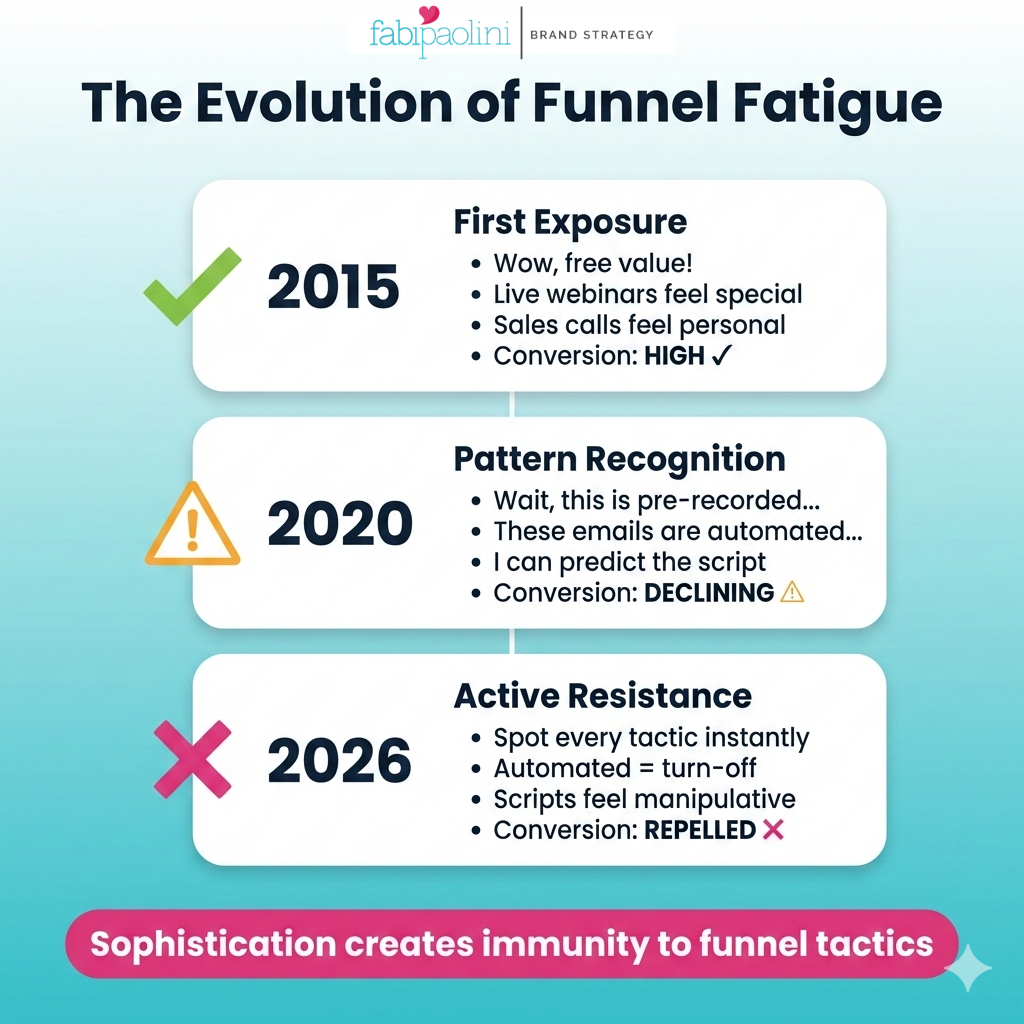
2015: They downloaded their first free PDF. They were amazed—"Wow, this is so valuable and it's free!" They watched a webinar. They were impressed by the transformation stories. They got on a sales call and felt special because an expert was spending an hour with them. They bought.
2020: They've been through this cycle 10+ times now. They start noticing patterns. "Wait, this webinar feels pre-recorded even though they said it was live." "These emails are clearly automated even though they sound personal." "This sales call is following a script—I can predict what question comes next."
2026: They can spot every tactic instantly. And those tactics don't just fail to convert them—they actively repel them.
This is what I call sales fatigue. It's not just awareness of tactics—it's psychological resistance to being funneled.
The Sophistication Problem Most Experts Miss
Most coaches and consultants see declining conversion rates and think: "I need better funnel tactics. Better subject lines. Better webinar scripts. Better objection handling. Better closing techniques."
But that's like thinking the solution to someone ignoring your pickup line is to practice delivering it more smoothly.
The problem isn't your delivery. The problem is the entire approach.
It's the same reason "Did it hurt when you fell from heaven?" might have worked at age 16, but by age 40, any rehearsed line—no matter how well-delivered—isn't flattering, it's off-putting. Because you can see the inauthenticity. You know they've used this on dozens of other people. You know they're following a playbook instead of actually connecting with you.
Your ideal clients have reached this level of sophistication with marketing funnels.
They don't want to be converted. They want to be understood.
They don't want a proven system that works for everyone. They want to know you actually understand their specific situation.
And you can't fake that. You can't script that. You can't automate that.
What Premium Clients Actually Want (And It's Not What You Think)
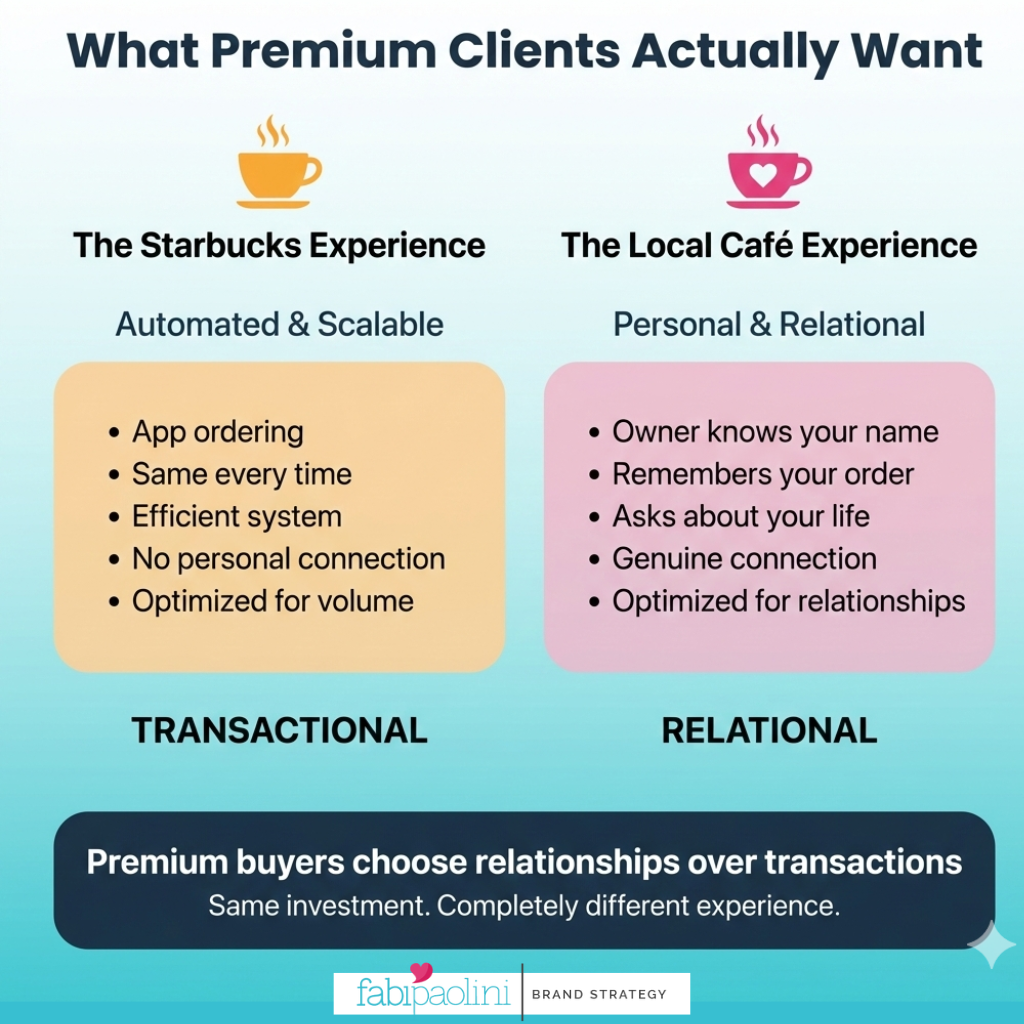
Sophisticated buyers making significant investments aren't looking for the Starbucks experience. They're looking for the local café.
Let me explain the difference:
The Starbucks Experience: The system is optimized. It's efficient. It's scalable. You order through an app, they make your drink exactly the same way every time, you pick it up from the counter. It works. It's fine.
The Local Café Experience: The owner remembers your name. She knows you take oat milk, no foam. She asks about your daughters. Some days you chat for ten minutes about nothing important. She might throw in a free pastry because she made extra and thought of you.
The transaction costs the same. But the experience is completely different. One is systematic. The other is relational.
When you're choosing who to trust with transforming your business—when you're making a $20,000+ investment—you're not looking for efficiency and scalability. You're looking to feel known. Understood. Like you're not just another lead moving through a funnel.
This is the fundamental shift that's happening in premium service marketing right now.
The Shift: From Conversion Optimization to Relationship Depth
Here's where most people misunderstand the "funnel is dead" concept. They think it means email marketing doesn't work or that automation is completely useless.
That's not it.
The shift is about what you're optimizing for.
Instead of optimizing for quick conversions, you're optimizing for relationship depth. Instead of pushing people toward a purchase decision, you're inviting them into your world.
Think about the difference between someone you meet at a networking event versus someone who becomes a close friend.
Networking event connection: You exchange pleasantries. "What do you do?" "Oh interesting, I do X." Surface-level conversation. Business card exchange. Perfectly pleasant but fundamentally shallow.
Real friendship: This develops through deeper conversations over time. You don't become close friends after one 30-minute coffee meeting where you both shared elevator pitches. You become close friends after the third dinner where you talked for three hours about how you think about life, what shaped your perspectives, what you've learned from failures.
You share stories that reveal your values. You explain your philosophy on things that matter. You go deep enough that the other person starts to understand not just what you think, but how you think.
That's what sophisticated buyers want from your content before they invest significant money with you.
They want to understand your philosophy. They want to see how you think about their problems differently than everyone else. They want to go deep enough to determine if your specific approach aligns with how they want to solve their challenges.
Why Shallow Content Attracts Browsers While Deep Content Attracts Buyers
When you create content optimized for quick engagement—listicles, quick tips, surface-level tactics—you attract people looking for free information. They consume your content and move on.
When you create content that goes deep—that reveals your unique diagnostic framework, that challenges common assumptions, that shows the sophistication of your thinking—you attract people who are serious about solving their problem at the highest level.
These are the people who will invest $20,000+ because they've already experienced the depth of your expertise through your content. They're not wondering if you can help them. They're evaluating fit and timing.
This is the distinction most experts miss when they're creating content. They're optimizing for reach and engagement rather than for relationship depth and buyer qualification.
Premium clients don't need more surface-level content. They need to see evidence of sophisticated thinking that makes them think, "This person understands my situation at a level others don't."
What Human-First Marketing Actually Looks Like in Practice
So what does this relationship-first approach actually look like? How do you build relationships that convert into premium clients without feeling sales-y or manipulative?
Instead of: Automated email sequences everyone receives
Do this: Send personal voice notes to people who engage with your content
Instead of: Rigid 15-minute call structures where you're watching the clock
Do this: Let conversations flow naturally when there's genuine connection
Instead of: Sales scripts designed to handle objections and create urgency
Do this: Focus on genuine connection and fit assessment—actually trying to understand if working together makes sense, not trying to convince someone to say yes
Instead of: Template responses to common questions
Do this: Take time to give thoughtful, personalized responses that demonstrate you actually read what they wrote
Instead of: Countdown timers and manufactured scarcity
Do this: Be honest about availability and let people make decisions without pressure
The result? People don't feel like they're being sold to. They feel like they're being understood.
And here's what I've discovered: when you prioritize genuine connection over conversion optimization, people don't just buy—they refer. They become advocates. They tell their friends, "You have to work with this person."
The Email Marketing Shift: From Manipulation to Genuine Value
I still use email marketing. Extensively.
But I use it to share authentic insights, personal perspectives, and real value—not to manipulate people toward a purchase.
My goal isn't to convert email subscribers into clients as quickly as possible. My goal is to build genuine relationships with people who could be a perfect fit.
The content I send demonstrates how I think about problems. It reveals my philosophy. It goes deep enough that people can determine whether my approach resonates with how they want to solve their challenges.
This means my emails are often long. They're substantive. They're not optimized for quick scans—they're optimized for depth of connection with the right people.
Most email marketing advice tells you to keep things short, use bullet points, make everything skimmable. That advice optimizes for mass appeal and quick engagement.
But I'm not trying to appeal to the masses. I'm trying to connect deeply with sophisticated buyers who are willing to invest significantly with the right expert.
Those people don't want skimmable content. They want substance. They want to see how you think, not just what you think.
Why "Scalability" Is the Wrong Goal for Premium Service Providers
Yes, this approach is less "scalable" than automated funnels.
But here's what I've learned: worry about scalability when you actually have that problem. Right now, your problem isn't scale—it's connection. Your problem isn't automation—it's relationships.
I'd rather have authentic relationships with 100 people than automated touchpoints with 10,000. I'd rather send personal voice notes to engaged prospects than have someone send template emails. I'd rather prioritize humanity over efficiency every single time.
Because sophisticated buyers don't need to be convinced. They need to be understood. And you can't automate understanding.
Think about what happens when you try to scale personal connection through automation:
You create templates for "personal" emails. But sophisticated buyers can tell the difference between a genuinely personal message and a template that uses their first name.
You record videos that attempt to create connection. But they can sense when something is pre-recorded versus actually live and responsive.
You develop scripts for "authentic" conversations. But they can hear when you're following a script rather than genuinely listening and responding.
The automation itself undermines the very connection you're trying to create.
The Metrics Shift: From Volume to Depth
When you shift from funnel thinking to relationship thinking, your metrics change entirely.
Old metrics:
- Email list size
- Webinar attendance rates
- Sales call booking percentages
- Close rates
- Time to conversion
New metrics:
- Depth of engagement with your content
- Quality of conversations you're having
- Percentage of discovery calls that feel like genuine fits
- Referral rates from existing clients
- Long-term client retention and ascension
The old metrics optimize for volume and speed. The new metrics optimize for fit and relationship quality.
And here's what's counterintuitive: when you optimize for relationship quality rather than conversion speed, your revenue often increases while your effort decreases.
Because you're not constantly chasing new leads through automated funnels. You're building genuine relationships with the right people who become long-term clients and consistent referral sources.
What This Means for Your Business Strategy
If you've been trying to build or fix your funnel, and it's not working the way it used to, the solution isn't a better funnel. It's a fundamentally different approach.
Stop asking: "How do I get more people into my funnel?"
Start asking: "How do I build deeper relationships with the right people?"
Stop asking: "How do I optimize my conversion rate?"
Start asking: "How do I help people genuinely understand whether I'm the right fit for them?"
Stop asking: "How do I automate my client acquisition?"
Start asking: "How do I create meaningful connection at every touchpoint?"
This shift requires letting go of the automation dream. It requires accepting that premium client acquisition isn't a system you perfect once and then scale—it's a relationship-building practice you get better at over time.
And yes, this is harder than following a proven funnel template. It requires more of you as a human being, not just as a business owner executing systems.
But here's what I know after building a multiple seven-figure business without funnels: the harder path is also the more sustainable path. The more human path is also the more profitable path. And the less scalable approach often creates more actual revenue than the scalable system that never quite works.
Common Objections to Human-First Marketing (And Why They're Wrong)
"But I don't have time for personal outreach to everyone who engages with my content."
You don't need to personally reach out to everyone. You need to personally reach out to the people who demonstrate they might be genuine fits. Quality over quantity. Ten meaningful conversations beat a hundred surface-level interactions every time.
"This approach won't work at scale."
You're not at scale yet. You're trying to attract premium clients. Once you have so many qualified prospects that you can't personally engage with them all, then you have a different problem. But most experts never reach that problem because they're focused on scale before they've mastered connection.
"Doesn't this take more time than automated funnels?"
Initially, yes. Long-term, no. Because you're not constantly troubleshooting why your funnel isn't converting, updating email sequences, split-testing landing pages, or managing complex automation. You're having conversations that either lead to great clients or don't. The energy expenditure is completely different.
"What if people take advantage of my generosity and just extract value without buying?"
Some will. That's fine. The people who are genuinely good fits will appreciate your generosity and reciprocate by investing when the timing is right. And the people who just extract value wouldn't have bought from a funnel either—they would have just consumed your lead magnet and disappeared.
"I thought I needed systems and automation to build a real business."
You need systems for delivery and operations. You don't need systems for human connection. The most successful premium service providers I know have highly systematized delivery and completely un-systematized marketing. They build relationships, not funnels.
The Bottom Line: Humanity Over Automation
The fundamental shift happening in premium service marketing is this: sophisticated buyers aren't looking for the cheapest option or the most convenient solution. They're looking for the right person.
Someone who understands their world. Speaks their language. Feels like the obvious choice for their specific situation.
This requires you to show up as a human being, not as a business system. It means being willing to have unscript conversations, to let calls run long when there's good connection, to send personal voice notes instead of automated emails.
It means prioritizing relationship depth over conversion speed. Connection over scalability. Understanding over convincing.
And yes, this is the opposite of what most business advice tells you to do. Most business advice is about systematization, automation, and scaling. That advice works for product businesses. It doesn't work for premium expertise-based services where trust and fit determine buying decisions.
The experts who are consistently attracting premium clients—the ones booking $20K, $30K, $50K engagements—aren't the ones with the most sophisticated funnels. They're the ones with the deepest relationships with the right people.
They've stopped trying to convert strangers through automated sequences and started building genuine connections with people who could be perfect fits.
That's what works now. That's what will continue working. Because it's based on something automation can't replicate: genuine human connection and understanding.
Ready to Implement Human-First Marketing?
Download the Human-First Marketing Blueprint
Get the step-by-step guide to replacing automated funnels with relationship-building strategies that convert premium clients:
- The 5 touchpoints where personal connection matters most
- Exactly what to say (and not say) in personal outreach
- How to identify genuine prospects worth investing time in
- Templates for voice notes, personal emails, and conversation starters
- The metrics that actually matter for relationship-based marketing
Want Expert Assessment of Your Current Approach?
Book a complimentary Brand Message Assessment where I'll review your current marketing approach and identify exactly where you're creating funnel resistance versus genuine connection.
On this 15-minute call, you'll get:
- Specific analysis of where your messaging feels automated versus authentic
- Identification of the touchpoints where personal connection would make the biggest difference
- Clear understanding of what's preventing premium clients from connecting with you
- Honest assessment of whether your approach aligns with how sophisticated buyers make decisions
Book Your Free Brand Message Assessment →
No pitch, no pressure—just strategic guidance on positioning that eliminates competitive comparison.
Frequently Asked Questions
How do I know if someone is a genuine fit worth investing time in?
Look for signs of genuine engagement, not just consumption. Are they asking thoughtful questions? Are they applying insights from your content? Are they investing time in understanding your approach? These signals indicate someone who's evaluating fit, not just collecting free information.
What if I'm naturally introverted and find constant personal connection exhausting?
Human-first marketing doesn't mean being "on" all the time. It means being genuine when you do connect. You can absolutely build relationship-based marketing with boundaries around when and how you engage. The key is that when you do engage, it's real rather than scripted.
Can I use any automation in a human-first approach?
Yes. Automation for logistics and operations is fine—automated calendar booking, payment processing, course delivery. What doesn't work is trying to automate the actual relationship-building and trust-development process.
How long does it take to see results with this approach?
Often faster than funnels, counterintuitively. Because you're having genuine conversations with qualified prospects rather than pushing people through sequences. Some clients book calls and sign contracts within a week of discovering you because the connection and fit are obvious. Others take months. But the quality of clients you attract is typically higher.
What about people who prefer self-guided buying journeys?
They can absolutely self-guide through your content. Not everyone needs personal connection before buying. But for premium offers ($10K+), most sophisticated buyers want some level of personal interaction to assess fit. You're optimizing for that group, not for everyone.
How do I transition from my current funnel to this approach?
You don't have to blow everything up overnight. Start by adding more personal touchpoints to your current process. Send voice notes instead of emails. Let calls run long when there's good connection. Notice what feels genuine versus scripted. Gradually shift toward what creates real connection and away from what feels mechanical.
About the Author
Fabi Paolini is a Brand Message Architect who developed the Angle of Mastery™ framework after recognizing that 85% of established coaches and consultants position themselves as comparable options rather than unique choices. With an MBA background in strategic positioning and experience working with hundreds of experts, she identified the pattern: premium clients don't choose the most credentialed expert—they choose the expert whose unique angle makes them the obvious fit for their specific situation. She built a multiple 7-figure business using Angle of Mastery™ positioning and now teaches other professional service providers how to occupy positions in the market that make competitive comparison irrelevant.
WATCH THE EPISODE BELOW

OR CLICK BELOW TO LISTEN ON: