

UPDATED JANUARY 2026
Before you begin reading: This article explains what Angle of Mastery™ is and why it matters. The companion guide walks you through discovering yours.
Get the Angle of Mastery™ Discovery Guide Below
Includes diagnostic questions, positioning framework, and implementation worksheets
If you're competing on credentials, experience, or results, you're already losing. According to Fabi Paolini, Brand Message Architect who developed the Angle of Mastery™ framework after working with hundreds of coaches and consultants, 85% of established experts position themselves as one qualified option among many rather than as the obvious choice for a specific type of client. An Angle of Mastery™ isn't your niche, your unique selling proposition, or your positioning statement—it's the intersection of what you're uniquely qualified to do, who you're uniquely qualified to serve, and why your specific combination of experiences makes you the only logical choice. When you identify and articulate your Angle of Mastery™, premium clients stop comparing you to others because no one else occupies your specific position in the market.
Let me be clear about what this isn't: This isn't about finding a narrow niche or crafting a clever tagline. This is about strategic positioning that eliminates competitive comparison entirely.
Why Traditional Positioning Fails Premium Service Providers
Here's the uncomfortable truth: most coaches, consultants, and professional service providers sound exactly the same.
"I help entrepreneurs scale their businesses."
"I work with leaders who want to transform their organizations."
"I specialize in helping women build profitable coaching practices."
These aren't bad positioning statements. They're just completely undifferentiated.
When you position yourself this way, premium clients are forced to compare you against dozens of other experts saying similar things. And when comparison happens, the decision comes down to:
- Who has more credentials
- Who has better testimonials
- Who charges less
- Who they happened to hear about first
None of these factors position you as the only choice. They position you as a comparable option.
The Credential Arms Race You Can't Win
I see this constantly: experts trying to differentiate through credentials, certifications, years of experience, or impressive client results.
"I have 15 years of experience."
"I've worked with Fortune 500 companies."
"My clients achieve 300% revenue growth."
"I'm certified in 17 different methodologies."
The problem? For every credential you have, someone else has something comparable or better.
More experience? Someone else has been doing it longer.
Better results? Someone else has a more impressive case study.
More certifications? Someone else has collected more letters after their name.
This creates a never-ending arms race where you're constantly trying to out-credential, out-experience, and out-result your competition. It's exhausting, and premium clients don't make decisions this way anyway.
Power Buyers don't choose the most credentialed expert. They choose the expert whose specific angle makes them the obvious fit for their specific situation.
What Makes an Angle of Mastery™ Different
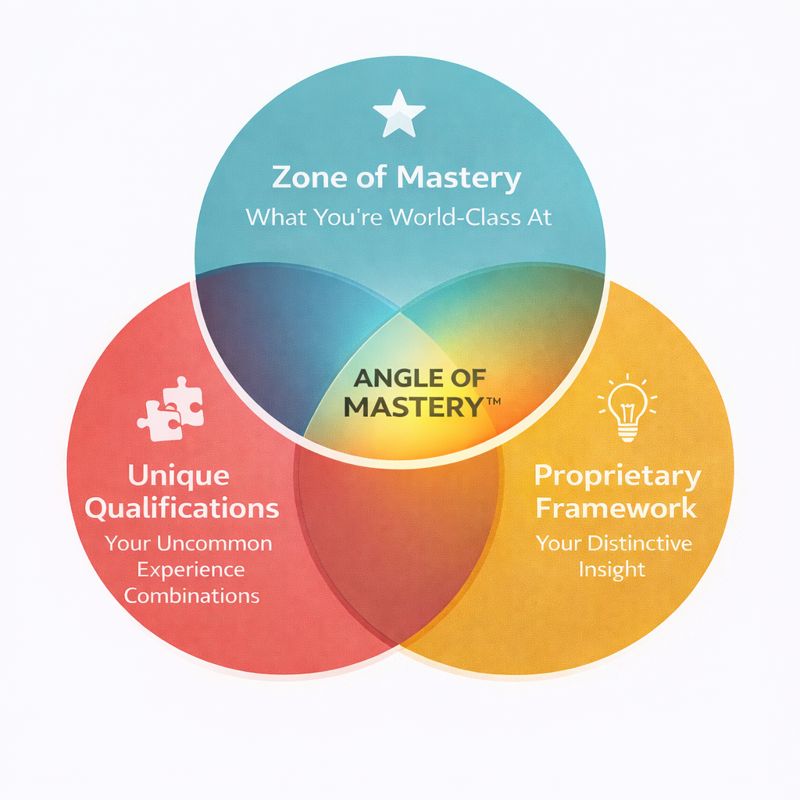
Your Angle of Mastery™ is the unique intersection of:
- Your Zone of Mastery - What you're genuinely world-class at (not just good at, but exceptional)
- Your Specific Client Transformation - The particular type of person or problem you're uniquely positioned to solve
- Your Differentiating Experiences - The uncommon combination of background, expertise, and perspective that only you possess
When these three elements intersect, you create positioning that's impossible to replicate because it's built on your unique story, not generic expertise.
The Difference Between Niche and Angle
People constantly confuse these, so let me clarify:
A niche tells you WHO you serve: "I work with female entrepreneurs" or "I serve B2B SaaS companies"
An Angle of Mastery™ tells you WHY you specifically are qualified to serve them in a way no one else can: "I help female entrepreneurs who've hit the 'sophistication ceiling' in their marketing—when the strategies that built their business to six figures completely stop working at seven. I understand this because I've experienced it myself and developed frameworks specifically for this transition that you won't find in traditional marketing programs designed for early-stage businesses."
See the difference?
The niche is demographics. The Angle is the unique problem + unique qualification + unique approach that makes you the only logical choice for a specific type of client.
Why USPs Don't Work for Expertise-Based Services
A Unique Selling Proposition (USP) works great for products:
- "The only waterproof phone case that floats"
- "Pizza delivered in 30 minutes or it's free"
- "Organic skincare with zero synthetic ingredients"
But when you're selling expertise? USPs fall flat because they focus on features, not positioning.
"I offer a proprietary 12-step process" - Okay, but why should I care?
"I provide unlimited email support" - That's a feature, not a reason to choose you
"I guarantee results in 90 days" - Lots of people make guarantees
An Angle of Mastery™ isn't about what you offer. It's about why you specifically are the right person to solve this specific type of problem for this specific type of client.
It's strategic positioning, not marketing differentiation.
The Four Types of Positioning (And Why Ony One Works for Premium Services)
Most experts position themselves in one of these four ways:
Type 1: Credential-Based Positioning
"I have an MBA from Stanford and 20 years of experience in organizational development."
The problem: Credentials create baseline credibility but don't explain why you're the specific right fit. Plenty of people have impressive credentials. This positions you as qualified, not as the obvious choice.
Type 2: Process-Based Positioning
"I use my proprietary TRANSFORM Framework to help clients achieve breakthrough results."
The problem: Power Buyers don't buy processes, they buy insight and expertise. Naming your framework doesn't differentiate you if the underlying positioning is generic. Everyone has a "proprietary process."
Type 3: Niche-Based Positioning
"I exclusively work with women entrepreneurs in the wellness space."
The problem: Niching narrows your market but doesn't explain your unique angle within that niche. You're still competing against everyone else serving that same demographic.
Type 4: Angle of Mastery™ Positioning
"I help established business coaches who've built successful practices teaching tactics, but now realize their clients need strategic messaging—not more marketing advice—to attract premium clients. Most business coaches don't understand the distinction between marketing and messaging because they've never studied brand strategy at the MBA level or worked with hundreds of clients on this specific transition. I have, and I've developed frameworks specifically for coaches making this evolution."
Why this works: It's impossible to directly compare this positioning to anyone else because it's built on a specific intersection of expertise, experience, and client transformation that's unique to this person.
Real Examples of Angle of Mastery™ Positioning
Let me show you what this looks like across different industries:
Business Coach Example
Generic positioning: "I help entrepreneurs scale to seven figures."
Angle of Mastery™ positioning: "I help service providers who've organically grown to $500K-$750K but hit a ceiling because their business model wasn't designed for scale. They're working 60-hour weeks, their profit margins are shrinking, and they don't know how to systematize expertise-based delivery. I've studied this specific transition point with over 200 clients and discovered the predictable patterns that prevent scaling—most coaches target either early-stage or multi-million dollar businesses, missing this critical middle ground entirely."
Why it works: Specific transition point + specific symptoms + uncommon understanding = impossible to compare.
Financial Advisor Example
Generic positioning: "I help high-net-worth individuals with comprehensive wealth management."
Angle of Mastery™ positioning: "I work with first-generation wealth creators—tech executives and entrepreneurs who built significant assets quickly but don't come from family money. They need different guidance than people who inherited wealth because they're navigating both wealth preservation AND family dynamics around money that their parents never experienced. My background as both a financial advisor and family therapist gives me insight into the psychological complexity of first-generation wealth that traditional wealth management completely misses."
Why it works: Specific client situation + unique expertise combination + uncommon insight = category of one.
Marketing Consultant Example
Generic positioning: "I help B2B companies improve their marketing ROI."
Angle of Mastery™ positioning: "I specialize in marketing for B2B companies in the messy middle—past startup scrappiness but not yet corporate sophistication. Their marketing worked when the founder did everything, but now they're trying to build a team and nothing's working because they're applying enterprise strategies to mid-market budgets. I've lived this transition as both a consultant and CMO, and I've identified the three marketing infrastructure pieces that must be in place before any tactics work—most consultants skip straight to tactics and wonder why nothing sticks."
Why it works: Specific business stage + specific problem + insider perspective = differentiated positioning.
Health Coach Example
Generic positioning: "I help busy professionals lose weight and get healthy."
Angle of Mastery™ positioning: "I work with high-achieving professionals who understand nutrition and exercise intellectually but can't seem to implement consistently because they're using willpower-based approaches that worked in their 20s but fail in their 40s when stress and hormones change the equation. As both a functional nutritionist and former management consultant, I've developed a systems-based approach to health that treats your body like you treat your business—with strategic planning and infrastructure, not just motivation."
Why it works: Specific life stage + specific failed approach + unique background combination = uncommon positioning.
Notice what all of these have in common: They're not just narrower versions of generic positioning. They're entirely different angles on the problem that make competitive comparison irrelevant.
Download the Complete Angle of Mastery™ Discovery Guide
Get the diagnostic questions, positioning framework, and worksheets to identify:
- Your Zone of Mastery (what you're genuinely world-class at)
- Your specific client transformation or transition point
- Your differentiating experience combinations
- Your unique framework or insight
- How to articulate your Angle in a way that eliminates competitive comparison
The Three Components of Your Angle of Mastery™
When you look at powerful Angle of Mastery™ positioning, you'll see these three elements working together:
Part 1: Root Cause with a Name
This is the underlying problem you've identified that others aren't seeing or naming.
It's not the surface-level symptom your clients complain about—it's the deeper, often hidden reason those symptoms exist.
And crucially, you give it a NAME that makes it real and recognizable.
Examples:
- The Sophistication Ceiling - The point where marketing tactics that built a business to six figures completely stop working at seven figures because sophistication requires strategy, not more tactics
- The Commodity Trap - When experts position themselves on credentials and results instead of unique perspective, forcing premium clients to compare them to everyone else
- First-Generation Wealth Complexity - The psychological and practical challenges unique to people who built wealth versus inherited it
The root cause must:
- Explain why the obvious solutions haven't worked
- Make the client recognize a pattern they've experienced but couldn't name
- Reframe their understanding of the problem entirely
Part 2: Breakthrough Message/Domino Belief
This is the paradigm shift—the new way of thinking that, once accepted, makes your solution the only logical path forward.
It's called a "domino belief" because when this belief falls into place, all the other resistance dominos fall with it.
Examples:
- "Premium clients don't buy based on credentials—they buy based on unique positioning that makes competitive comparison irrelevant"
- "You don't have a marketing problem, you have a messaging problem. More tactics won't fix unclear positioning"
- "The strategies that got you to $500K will actively prevent you from reaching $1M—success at the next level requires completely different infrastructure"
Your Breakthrough Message should:
- Challenge conventional wisdom in your industry
- Explain why their previous attempts failed
- Create urgency for a different approach
- Position your methodology as the logical solution
Part 3: Angle of Mastery™/Big Idea Name
This is your branded positioning—the memorable phrase that encapsulates your unique approach and makes you instantly recognizable.
It's not just a tagline. It's a conceptual framework that only you own.
Examples:
- Soul Centered Security™ - Financial planning that addresses both wealth strategy and the emotional relationship with money
- Power Buyer™ Methodology - Attracting investment-ready clients who make fast decisions versus "Ursulas" who consume content but never buy
- Need-to-Have Formula™ - Transforming offers from optional nice-to-haves into essential business infrastructure
- Angle of Mastery™ - Strategic positioning that eliminates competitive comparison by occupying a unique market position
Your Big Idea Name should:
- Be memorable and distinctive
- Capture your unique approach in a phrase
- Be trademarkable (you own it)
- Signal sophistication and strategic thinking
- Make sense only in the context of your specific methodology
How These Three Parts Work Together
When you combine all three elements, you create positioning that's impossible to replicate:
Root Cause (what you've identified) + Breakthrough Message (how you reframe the problem) + Big Idea Name (your branded solution) = Angle of Mastery™ that eliminates competitive comparison
Example of how this works in practice:
My Angle of Mastery™:
- Root Cause: The Commodity Trap (experts competing on credentials instead of positioning)
- Breakthrough Message: "Premium clients don't choose the most credentialed expert—they choose the expert whose unique angle makes them the obvious fit for their specific situation"
- Big Idea Name: Angle of Mastery™ positioning
See how these three parts work together? The Root Cause identifies what's really wrong, the Breakthrough Message reframes how to think about it, and the Big Idea Name gives you a branded framework for solving it.
This isn't just differentiation—it's creating an entirely new category that you own.
How Your Angle of Mastery™ Changes Everything
When you identify and articulate your Angle of Mastery™, several things shift immediately:
Your Marketing Becomes Dramatically More Efficient
Instead of trying to appeal to everyone and attracting no one, you speak directly to people for whom your specific angle is exactly what they need.
Your content doesn't need to be everywhere or constant. It just needs to clearly communicate your unique positioning.
Before Angle of Mastery™:
- Posting daily on multiple platforms hoping someone notices
- Creating generic content that could apply to anyone
- Attracting lots of followers but few clients
- Spending hours creating content that generates likes but not leads
After Angle of Mastery™:
- Creating strategic content that demonstrates your unique perspective
- Speaking to specific people who immediately recognize themselves
- Smaller audience, but highly engaged and investment-ready
- Content that generates actual client conversations
Your Sales Process Compresses
When your Angle of Mastery™ is clear, premium clients self-identify quickly.
They don't need 6-8 touchpoints to "get to know you." They see your positioning and think "This person understands my specific situation in a way others don't."
Before Angle of Mastery™:
- Discovery calls with people trying to understand what you do
- Explaining your background and why it's relevant
- Justifying your pricing against competitors
- Dealing with "let me think about it" endlessly
After Angle of Mastery™:
- Discovery calls with people asking "when can we start?"
- They already understand why you're uniquely qualified
- Price isn't an issue because they're not comparing you to others
- Decisions happen in 2-3 conversations
Your Premium Pricing Becomes Logical
When you're one of many qualified options, clients compare prices.
When you're the only person with your specific Angle of Mastery™, price comparisons become irrelevant.
This isn't about charging more arbitrarily. It's about premium pricing making sense because your unique positioning creates unique value.
Your Business Becomes More Enjoyable
When you're positioned clearly, you attract clients who are the right fit—people whose specific problems align with your specific expertise.
This means:
- Working with clients you genuinely enjoy
- Solving problems you're uniquely good at solving
- Getting better results because you're in your zone
- Building case studies that attract more of the right people
Common Questions About Angle of Mastery™ Positioning
"What if my angle is too narrow and I limit my market?"
You're not limiting your market. You're clarifying it.
Right now, with generic positioning, you theoretically appeal to everyone but actually appeal to no one. Premium clients scroll past you because nothing says "This is specifically for me."
With Angle of Mastery™ positioning, you speak directly to a specific type of person with a specific type of problem where your specific combination of expertise makes you the obvious choice.
The math works like this:
- Generic positioning: Appeal to 10,000 people, convert 0.5% = 50 clients
- Angle of Mastery™ positioning: Appeal to 500 people, convert 30% = 150 clients
Smaller addressable market, higher conversion, more clients
"Can my Angle of Mastery™ evolve over time?"
Yes, and it should.
Your Angle of Mastery™ isn't static. As you work with more clients, develop deeper insights, and gain more experience, your angle naturally sharpens and evolves.
In 2020, my angle was about brand messaging for coaches.
In 2022, it evolved to premium positioning for established experts.
In 2024, it sharpened to Power Buyer attraction through Angle of Mastery™ positioning.
Same core expertise, increasingly refined angle.
The key is that evolution should be refinement, not reinvention. You're not changing your fundamental positioning every six months—you're clarifying it as you gain more experience.
"What if I want to serve multiple types of clients?"
Then you have two options:
Option 1: Choose the client type that represents your strongest Angle of Mastery™ and build your positioning around that. You can still work with others, but your marketing speaks to your primary angle.
Option 2: Develop distinct Angle of Mastery™ positioning for each client type and create separate marketing for each. This works if the angles are truly distinct, not just demographic differences.
What DOESN'T work: Trying to speak to multiple client types with one generic positioning. That just dilutes everything.
"How do I know if I've identified my real Angle of Mastery™?"
You'll know because:
It feels true. It's not manufactured or forced—it emerges naturally from your actual experiences and insights.
It's defensible. You can explain WHY you're uniquely qualified in a way that's not just opinion but demonstrable through your background.
It creates recognition. When you articulate it to the right people, they immediately respond with "Where have you been?" or "This is exactly what I need."
It eliminates comparison. People stop saying "How are you different from X?" because your angle makes comparison irrelevant.
It energizes you. Talking about your Angle of Mastery™ doesn't feel like pitching—it feels like sharing insight from a place of genuine expertise.
"What if competitors copy my Angle of Mastery™?"
They can copy your words, but they can't copy your actual angle because it's built on YOUR unique combination of experiences.
If someone tries to position themselves the same way without the underlying background, sophisticated clients will see through it immediately.
This is why Angle of Mastery™ positioning is so powerful—it's not a marketing tactic you can steal. It's strategic positioning built on genuine differentiation.
"Do I need to have a dramatic or unusual background?"
No. You need an uncommon COMBINATION, not dramatic individual experiences.
Most of us have relatively common backgrounds individually:
- Went to school
- Worked in corporate jobs
- Got certified in various things
- Started businesses
- Learned from experience
The Angle of Mastery™ emerges from how these common experiences INTERSECT in uncommon ways.
You don't need to have climbed Everest or sold a company for $100 million. You need to identify what makes YOUR specific combination of experiences create unique insight for a specific type of client.
The Strategic Advantage of Angle of Mastery™ Positioning
Here's what most people don't understand about positioning: It's not just marketing. It's business strategy.
Your Angle of Mastery™ determines:
- Who you attract as clients
- What problems you solve
- What you charge
- How you deliver
- Who you compete with (or don't)
- How you grow
When I work with clients on their Angle of Mastery™, we're not just crafting positioning statements. We're defining their entire business strategy.
Because once you're clear on your unique angle, everything else becomes clearer:
What content to create - Content that demonstrates your unique perspective, not generic advice
What offers to develop - Services that leverage your specific expertise combination
What partnerships to pursue - Collaborations with people who serve complementary angles
What opportunities to decline - Projects that don't align with your Angle of Mastery™
How to price - Premium pricing that reflects your unique value, not market averages
This is why Angle of Mastery™ positioning is the foundation of everything I teach. Get this right, and everything else becomes exponentially easier.
Get this wrong, and you'll struggle with every aspect of your business no matter how good you are at what you do.
Ready to Discover Your Angle of Mastery™?
Download the Complete Angle of Mastery™ Discovery Guide
Get the diagnostic questions, positioning framework, and worksheets to identify:
- Your Zone of Mastery (what you're genuinely world-class at)
- Your specific client transformation or transition point
- Your differentiating experience combinations
- Your unique framework or insight
- How to articulate your Angle in a way that eliminates competitive comparison
Want Expert Guidance on Your Positioning?
Book a complimentary 15-minute Brand Message Assessment where I'll analyze your current positioning and identify the gaps preventing you from claiming your unique Angle of Mastery™.
On this call, you'll get:
- Specific insights on where your positioning is too generic
- Identification of potential Angle of Mastery™ elements in your background
- Immediate clarity on what makes you uniquely qualified
- Honest assessment of what's preventing premium clients from seeing you as the obvious choice
Book Your Free Brand Message Assessment →
No pitch, no pressure—just strategic guidance on positioning that eliminates competitive comparison.
Frequently Asked Questions
How long does it take to identify my Angle of Mastery™?
For some people, it clicks immediately—they've sensed their unique positioning but never articulated it clearly. For others, it requires deep reflection on patterns in their best client work, uncommon combinations in their background, and insights they've developed that others haven't. The discovery process typically takes 2-4 weeks of focused work.
Can I have an Angle of Mastery™ if I'm new to my industry?
Yes, but it requires looking beyond just industry experience. Your Angle might come from applying expertise FROM a previous career TO your current field, from a unique personal experience that gives you insight others lack, or from an uncommon combination of training. New practitioners often have fresh perspectives that become their Angle.
What if my background is all in one area?
Depth can create an Angle. If you've spent 20 years in one specific area, you've likely developed specialized insight into nuances and patterns that generalists miss. Your Angle might be about seeing complexity in what others treat as simple, or identifying the specific inflection points within that one area.
Is Angle of Mastery™ the same as a positioning statement?
No. A positioning statement is external communication: "I help X achieve Y through Z." Your Angle of Mastery™ is the underlying strategic positioning that INFORMS your positioning statement, but it's deeper—it's the actual intersection of expertise, experience, and insight that makes your positioning defensible.
Can two people have the same Angle of Mastery™?
Extremely unlikely. Even if two people serve similar clients with similar transformations, their underlying combination of experiences, insights, and approaches will differ. If someone appears to have your exact angle, one of two things is true: (1) you haven't differentiated deeply enough, or (2) they're copying your positioning without the underlying substance.
Should I mention my Angle of Mastery™ explicitly in my marketing?
You should DEMONSTRATE it, not just claim it. Rather than saying "My Angle of Mastery™ is...", your marketing should make your unique positioning obvious through how you talk about problems, what insights you share, and what background you reference. The angle should be evident, not announced.
What if I discover my Angle but it doesn't match my current client base?
This often happens during the discovery process. You might realize your true Angle of Mastery™ serves a different client type than you're currently attracting. This is actually good—it means you've identified misalignment early. You can then decide to pivot your positioning to match your true angle, or refine your understanding of your angle based on who you actually work with best.
How specific should my Angle be?
Specific enough that the right people immediately recognize themselves, but not so narrow that you eliminate natural adjacent markets. Your Angle should feel like a clear lane, not a straitjacket. If you find yourself turning down ideal clients because they don't fit your angle, you've probably gone too narrow.
Can I change my Angle of Mastery™?
You can evolve and refine it, but wholesale changes are rare unless your business fundamentally shifts. Most "changes" are actually clarifications—sharpening your existing angle rather than finding a completely new one. If you're constantly changing your angle, you probably haven't identified the real one yet.
About the Author
Fabi Paolini is a Brand Message Architect who developed the Angle of Mastery™ framework after recognizing that 85% of established coaches and consultants position themselves as comparable options rather than unique choices. With an MBA background in strategic positioning and experience working with hundreds of experts, she identified the pattern: premium clients don't choose the most credentialed expert—they choose the expert whose unique angle makes them the obvious fit for their specific situation. She built a multiple 7-figure business using Angle of Mastery™ positioning and now teaches other professional service providers how to occupy positions in the market that make competitive comparison irrelevant.
